Jwquaker's Blog
community
Wheat and Rye (Sermon July 20, 2014)
Scripture: Matthew 13:24–30, 36-43 (NRSV)
The Parable of Weeds among the Wheat
24 He put before them another parable: “The kingdom of heaven may be compared to someone who sowed good seed in his field; 25 but while everybody was asleep, an enemy came and sowed weeds among the wheat, and then went away. 26 So when the plants came up and bore grain, then the weeds appeared as well. 27 And the slaves of the householder came and said to him, ‘Master, did you not sow good seed in your field? Where, then, did these weeds come from?’ 28 He answered, ‘An enemy has done this.’ The slaves said to him, ‘Then do you want us to go and gather them?’ 29 But he replied, ‘No; for in gathering the weeds you would uproot the wheat along with them. 30 Let both of them grow together until the harvest; and at harvest time I will tell the reapers, Collect the weeds first and bind them in bundles to be burned, but gather the wheat into my barn.’ ”
Jesus Explains the Parable of the Weeds
36 Then he left the crowds and went into the house. And his disciples approached him, saying, “Explain to us the parable of the weeds of the field.” 37 He answered, “The one who sows the good seed is the Son of Man; 38 the field is the world, and the good seed are the children of the kingdom; the weeds are the children of the evil one, 39 and the enemy who sowed them is the devil; the harvest is the end of the age, and the reapers are angels. 40 Just as the weeds are collected and burned up with fire, so will it be at the end of the age. 41 The Son of Man will send his angels, and they will collect out of his kingdom all causes of sin and all evildoers, 42 and they will throw them into the furnace of fire, where there will be weeping and gnashing of teeth. 43 Then the righteous will shine like the sun in the kingdom of their Father. Let anyone with ears listen!
Most people li ke a good story. A story teaches, and encourages, but most of all a good story will stick with you for a while, several days or even years down the paths of life you will remember the story. Something about a situation we are in several years down the road will cause us to remember words spoken to us and we will begin to understand things just a bit more.
Jesus told stories that even after nearly 2000 years we are still learning from. They spoke to the conditions of the times in which he told them, and they continue to speak to us now, even though most of us are not engaged in the same sort of lifestyle as the people in first century Judea.
Last week we contemplated the story Jesus told about the sower and the seeds. We considered the possibility that soils change as conditions change. Good soils if left unattended can become filled with weeds, and how hard and rocky soils with proper care can become good. I mention this because like most people we often think of things in a moment. Initially we assume that a hard hearted person will never change, but we tend to forget that it takes time for soils to become hard. Constant traffic walking all over a heart with very little care given to the wellbeing of an individual’s spiritual life can make any heart hard. So it will take continuous encouragement and time to work thought the hardness that was brought about by abuse and neglect.
Just as with the hard soils the rocky soils can be changed. Rocks can systematically be found and removed under the care of the farmer, and when the rocks are removed the plants can then grow freely. Weeds as well can be pulled from the rows allowing space for the crops to grow. Initially we assume that soils and people do not change. But imagine just for a moment if our ancestors lived with the idea that soils could not change? The states of Missouri and Kansas would never have been settled because many thought that the grass lands were unproductive soils. After this year’s harvest my family might agree with them. But our ancestors knew that soils under proper care could become productive, and if you had land of your own you could become successful and raise your family.
Imagine again if someone were have similar thought of you personally. Many considered the high plains of Kansas as being too hard, rocky, or weedy to be productive. Imagine if everyone that knew the gospel continued to neglect you as if you were a lost cause. Too hard hearted, too rocky, or filled with too many weeds.
To consider the parable we read today we must first remember the parable of the sower and the seeds, because just like a farm our spiritual lives are complex and need constant attention and care. Jesus begins by saying, “The Kingdom of Heaven may be compared to…” This is an important place to start because we may risk understanding the entire parable if we first do not hear this statement properly. John the Baptist would cry out in the wilderness, “Repent for the kingdom of heaven is near.” And Jesus would also say similar things when He began to teach. The term near or at hand as some translations state it, is a word that is much deeper than we may think. At first we may consider it to be a term of time, as if saying the time is near, but that is not the whole story. Near or at hand means that it is all around in the air, the kingdom is near because it is right here with us. This is important because if the kingdom is all around us here now today as well as tomorrow and on into the end of ages, why do we not see it. This is the key to understanding this parable that Jesus spoke. When we consider the kingdom only to be a future event it has little effect on our lives today, but when it is all around us and we can actively live within the kingdom today as we will in eternity it can change how we interact with those around us.
The kingdom of Heaven may be compared to someone sowing good seed into a field. We can look at this passage from many different angles and interact with it through many different eyes. But if the field in the prior parable is the lives of individuals, I want us to consider the field in this parable in that manner as well. I say this because often we read the field as being the church and the seeds as being the individuals, as I was studying and praying with this passage this week I really felt that by looking at this parable in that manner we can get a very jaded view of the church and Kingdom, and a fatalistic view of the ministry. I also felt the need to look at this parable from a personal and intimate mindset because it enriches our understanding of the spiritual struggles that we each face as we walk the pathways with Christ.
A man sows good seed in the field and while he is asleep an enemy comes in and sows weeds among the wheat and goes away. And as the plants grew so did the weeds. The slaves say to the master, “Did not you sow good seeds in your field? Where, then, did all these weeds come from?” This is a wonderful question. Where did all the weeds come from? When we look at this story as your own spiritual journey with Jesus, I am sure many of you, as I do, ask this about your own lives. Over all our lives are filled with goodness, but every so often something pops up in our lives that just isn’t filled with the grace that God has shown us. We can be living our lives singing praises in our cars as we drive to the store, and suddenly someone pulls in front of us unexpectedly and the mouth that was just singing praises to God lets out a string of words that are filled not with grace but curses. Or maybe we spin a story we heard to mean something totally different from the truth, and the rumor weeds begin to emerge along with the seeds of spiritual growth. And we ask ourselves, “Where did all these weeds come from?”
Jesus tells this parable because this is actually a form of warfare that was used, and in some cases is still used in the world. If you want to hurt a person or a culture to gain power or influence, if you take out the food supply the people generally are less able to struggle against you. The weeds that Jesus refers to is a type of rye. In the Hebrew culture wheat infested with rye was considered unclean and in some cases dangerous, because rye is highly susceptible to a fungus called ergot
. If someone was to consume ergot they could become intoxicated to the point of hallucinations. Many scholars believe that ergot was at the root of the Salem Witch trials, because this tainted grain was being eaten because there was not enough good grain to eat. So with that bit of knowledge we can understand that there are spiritual battles that rage among us that at times can become intoxicating and cause us to do things we may not desire to do.
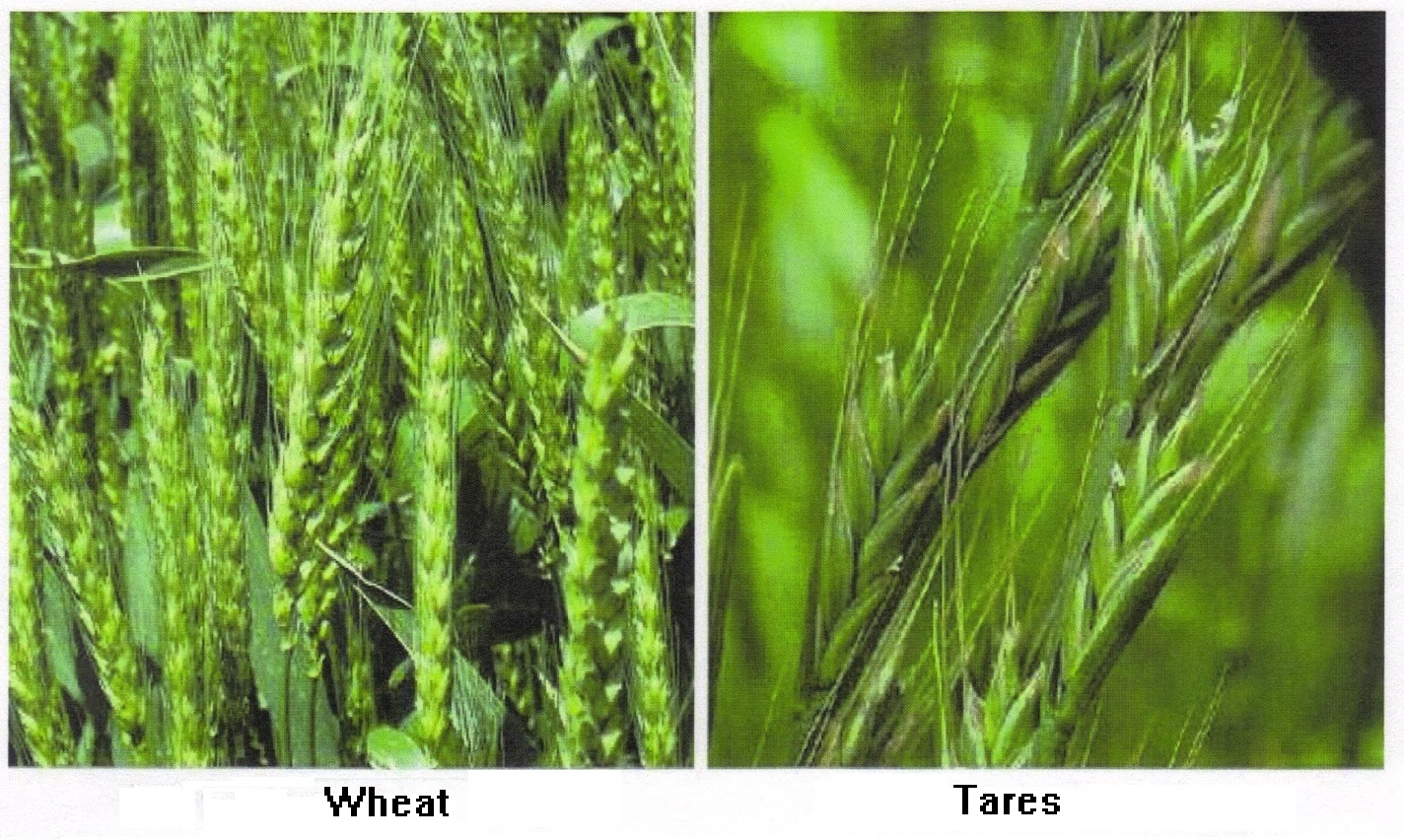
The servants want to go in and pull out the weeds, but how does the Master in the story respond? He advises his servants to let the weeds grow because if they were to pull out the weeds they would uproot the wheat as well. Consider this for a moment? Why would we want to let detrimental weeds grow in our lives? Why would it be unwise to go in a remove the unwanted plants from the fields? Jesus in essence is saying let people sin. Why would a righteous God who demands holiness allow the weeds to continue to grow?
Without untrained eyes it would be difficult to determine what is good and what is bad when it comes to wheat and rye. For most of us in this room, we could go into the field and we would not have any idea where to even begin. So we would begin to uproot plants, not knowing if we were pulling a weed or the crop. Even seasoned farmers often have a hard time distinguishing the difference until the plants have grown larger, because the differences in the early stages of the plant are almost microscopic. We must allow time to run its course.
This story is a good story. It tells us a great deal about good intentions and how we can cause great harm if we are not disciplined. If the servants of the master went out and began to uproot plants trying their hardest to make sure the harvest was good, they could very easily cause ruin. It is difficult to let things sit when you know something is wrong. It is hard for us to let seeds of grace mature without stepping in to try to pull out the seeds of evil in the lives of those we are serving. But we have to wait for the master to let us know when to act. It is not our harvest, but God’s. It is not our field that is being worked but His. We do not and cannot change the spiritual fields ourselves but must work with and under the direction of our master.
This requires us to become disciplined in our own lives. Working on little things in ourselves first and then encouraging others. We first need to follow the rhythm of life that Jesus showed us; a life where we make it our custom to worship, where we withdraw to the isolated places to pray, and then to go out into the fields to minister where the master has lead us. Without this rhythm we are unable to discern the voice of the master. Without this disciplined life we are unable to see the difference between the wheat and the weed. But even with this disciplined life we must be careful. A few months ago I spoke about the stages of belief: the first being knowledge, the second being trust, and the third being entrust. These stages of belief also play a role in how well we are able to handle the kingdom of heaven.
Those that act on knowledge, but without trust will often move forward without discernment and cause harm, even with good intentions. Those that fail to entrust their lives and the lives of others into the care of God, will often find that their lives may have uprooted the seeds of grace and are now nurturing plants with poisonous intoxicating properties. This is why the gospel writers included the spiritual practices of Jesus in their stories and why they included his parables alongside his miracles, so that we would be able move from one stage to the next.
So why do we wait to pull the weeds? Coming from an agricultural background I understand these agronomic parables better than some, and since I have a degree in crop science it helps as well. While studying for my degree, I actually had to take classes dealing with the study of soils, the study of crops, and the study of weeds. These classes were to train us in how to encourage the earth to produce as much as possible, how to choose which plants to grow where, and how to identify potential issues before they became a problem. I often thought that in becoming a pastor in an urban setting these skills I learned in school and on the farm might have been wasted but then I read scripture. Why does Jesus ask his servants to wait? Rye matures faster than wheat, so as the plants mature you can identify them and cut them out before the harvest of wheat begins. So when Jesus is telling us to wait to pull the weeds, he is telling us that if we wait we will see more clearly, we will nurture the good seeds and then the contrast between the good and bad become more visible.
Often those in the church fail to see the kingdom all around us because we are too focused on the weeds instead of focusing on the seeds of grace that God has called us to nurture. We see all that is wrong with the world, and want to act before God has had a chance to get the good seeds established. The problem with that type of view is we become our own worst enemy. We work hard to nurture the lives around us and then we begin pulling weeds and in the process uprooting the spiritual lives of the ones we are called to minister too. In our desires to groom righteous people we forget to teach discipline and stop the deeper establishment of belief. The kingdom of Heaven is all around us. The early friends would explain it as the spark of light in everyone, our job as followers and Friends of Christ is to nurture and feed the light, fertilize and water the seeds of belief until the hearts are a blaze and the flowers are in bloom. We do not see the kingdom around us because often we have stopped tending the fields.
As we enter into this time of open worship and communion as Friends let us consider the wheat and the weeds, let us consider the stages of belief and the rhythm of life that Jesus taught us. Let us look at how we can assist our master in his fields by nurturing the seeds he plants and let the angels cut out the rye that the evil one has planted to confuse and hinder us. And let us become people walking along with Jesus as he worships, prays, and serves those in his community; and become a people Loving God, Embracing the Holy Spirit, and Living the Love of Christ with other.
Working the Soils (Sermon July 13, 2014)
Scripture: Matthew 13:1-9, 18-23
There is something powerful about a story. Stories have a strange power that can transport us from one place and time in to a totally different universe. This is why so many of us enjoy a good book or movie, those stories take us from our living rooms and transport us to worlds far in the future, or deep into history. A good story often has a theme that encourages us in some way. There is usually an obstacle of some sort that the main character must overcome. Or there may be some sort of ethical issue in which the story teller is prompting us to consider through the facilities of imagination. This is why some of the greatest teaching Jesus has are not in the explanation of scriptures, but the seemingly entertaining metaphorical stories he tells.
The seeds, it is a story that we have each listened to so often that I wonder if we really listen to it any more. But imagine you had not heard it. You came to the seaside to listen to this traveling teacher and the crowd is so large that to be heard the teacher gets onto a boat and floats out a ways using the terrain as a natural amphitheater. You are anticipating the message you are about to hear, and you are hoping that you will be able to see a miracle.
Jesus looks out at the crowd and begins to speak. There was a farmer that was scattering seeds, the seeds fell in various different places. Some fell on the path where the birds came and ate them, others fell in rocky soil and grew rapidly but quickly withered. Some of the seeds fell among the weeds and were choked out and others fell on good soils and produced an abundance. Then he looks out at the crowd again, says “Let anyone with ears listen,” and he sits down in the boat. The teaching is over because he has now turned his attention away from the crowd and is focused only on his closest followers.
Consider that for a moment. That was the entire sermon that Jesus gave at that moment. No further explanation, no deeper discussion explaining the metaphors to the masses, He simply told a story and left it hanging there in the air. Concluding by saying “Let anyone with ears listen.”
Often we think a story is just entertaining and fun, but often the deepest and most meaningful expressions of faith come from the simplest stories. These simple stories of overcoming obstacles and finding a pathway through a struggle our culture yearns for from the deepest parts of their beings. This is something that humanity has always loved. The story of your life is one of the most powerful things this world has ever heard. The story of how you struggle and found hope even in the darkness, is often a balm for the wounded hearts attached to listening ears.
The sower and the seeds. For many of us is a simple story of a farmer, but in ancient times it was not as simple as we might think. Notice the first illustration that Jesus uses, “Some seed fell on the path, and the birds came and ate them up.” The words used in this phrase to a listening ear is packed full of spiritual imagery. Although some birds were used as symbols of grace, and used in temple worship, birds were often seen as robbers in the culture. When a farmer had an infestation of birds their livelihood was stolen from them. As Jesus explains later to his disciples, the path is a heart that has been hardened so even though grace and mercy is scattered over that heart the hearer of the words do not sense it. Quickly the minions of evil rob that person of the words of life before the grace even has a chance to germinate. To go a bit deep the phrase, “ate them up,” is a term that is also used for devour, exploit, or to take advantage of. If we were to consider that for a moment we get a very different picture of these hardened people.
A path is a place where foot traffic has compacted the soil. A hardened heart is a heart that has been exploited and used, it is a person that has been abused by its culture so long that it resists any and all mercy. We each know these types of people, when you talk to them they are immediately skeptical and pessimistic.
Jesus continues, “Other seeds fell on the rocky ground, where they did not have much soil…” Rocky soil is a soil of transition, it is either in the process of being trampled and packed or nurtured to become productive. There is something there that responds to the seeds of grace, but Jesus says the sun comes out and they wither because they have no root. These rocky hearts are extremely vulnerable. They often respond to encouragement but can also be quickly turned away. I fear for these types of individuals, because often they can get caught up in the emotionalism of a moment but when their life experiences do not meet their expectations they can quickly become hard.
For example I was in a conversation with a leader of another denomination, this particular leader made an observation that there was a great deal of turnover in leadership among their group and he was reaching out to other Christian leaders for advice. This particular group was one that based the majority of their teaching on excitement, emotions, and blessing. In this leader’s group they would have leaders rise and fall away within a couple of months, leaving him questioning why. Groups like this are vulnerable to the rocky soil believers, they get excited about ministry and life with God and as long as there is not any struggle in their life, they continue to participate, but as soon as they encounter a difficulty they question everything about their faith. They enter into pastoral leadership, but they run into financial difficulties and resign, they begin to lead bible studies but then they have marital struggles and suddenly they question if God even exists. Many of these people then become hardened to the gospel because they tried it once and it did not work, they tried God and He did not bless them and in many cases they left in worse shape than they began.
Jesus continues to speak about the seeds that fell among the thorns and were choked. These are lives that are filled with various worries and distractions. Lives that have so many demands on time and attention that there is no room for anything else. These people by in large are good people, these people if you were to ask them actually say that they believe in God, but they are just unable to grow in their faith because the soils of their life are filled with other things. Our culture by in large is filled with people like this. We are a busy people. We juggle multiple jobs and our family. We have debts that need repaid and mouths to feed, even when we have a few hours to relax we fill that time with things that are equally as demanding as everything else. We like the idea of God, but a relationship with God is just something that will have to wait.
Jesus is teaching to people that understand agriculture. Those listening to this story, if they themselves are not a farmer, know someone who is. They have each observed each of these sorts of situations. They experienced birds robbing them of crops by eating the seeds, they have seen plants quickly taking off and withering away as the temperature rises, and they have seen the weeds choke out the plants that they hoped would feed their families. They also know that the earth is constantly changing and that with proper and intentional care any field can become productive.
Often when we listen to this story we look at it from a position that all soils and all people will not or cannot change. That is not the case. Good soils can become bad and poor soils can become good if we work with them according to their specific needs. So we must then consider what we as ministers of the Gospel of Jesus should do to prepare lives for the seeds of grace? The goal of our efforts is to harvest of the planted seeds. We first keep that goal in mind, but we also have to recognize the situations around us. Jesus is saying to these listening ears in this simple story, that just like a farm a relationship with God takes a lot of work. This is the reason Jesus came to live among us, to show us how to tend the fields of life. It is through the life that has joined into the spiritual rhythm of Jesus’ example that we are able to tend the fields of our community. The rhythm of worship, prayer, and service are similar to the efforts a farm employs in the fields.
The work first begins in our own lives, because we cannot share with others what we ourselves do not possess. When we enter into the spiritual rhythm Jesus has shown, we remove the weeds as we learn through worship and prayer what areas of our own lives can be simplified, and as we simplify our lives we can then encourage others to simplify theirs as well. When we intentionally make time to pray we quickly recognize all the things that are making demands on our time, examine those demands and weed out the ones that are distracting us from the goal of a harvest.
We also may observe not only weeds but rocky areas that prevent deepening roots, things that may threaten our very faith. What do we do to remove these rocks? Rocky soils are everywhere on earth. Ireland is considered to be the Emerald Isle, but the field though rich were also filled with rocks left buried after the glaciers of the Ice age receded from the land. For the farmers in Ireland to use the land to grow crops they had to dig into the ground and pull these rocks out, and they would then carry them to the edge of the field and stack them up. Eventually they removed so many rocks they build walls between the fields, walls that have become monuments to the persistence and dedication of man to survive. In our lives rocks could be many things. They can be addictions or choices that we may not be able to overcome on our own. This is where the church is so important, because it is in the church where we find others that have had similar issues and are willing to help us dig and carry the stones to build monuments of grace. To remove the rocks from the soils of our community requires the Disciples of Christ to become vulnerable and open to others. We become willing to share the areas of life that we have struggled and are willing to help others if asked. It also requires us to be willing to ask for help when we see a need in our own lives.
Prayer and worship assist us in removing the weeds and the rocks of our lives, but it also opens our eyes to be able to see the areas of our community where the seeds of grace are being devoured by the wild birds of the evil one. In the spiritual rhythm Jesus taught and showed us that worship and prayer leads us into service and ministry to the ones least in the community. These are the people that have been exploited and trampled and are so hardened in life that they cannot even begin to contemplate God. But hard soils can be remedied. It requires us to get out into the community to constantly work the soil, using the gifts and tools that God has given us to feed the hungry, clothe the naked, and help cleanse the ones that are unable to help themselves. These are the ones that will despise us and persecute us but they do that because they have hardness in their hearts and the grace and love of God is being snatch away before they have a chance. To break through the hardest soils requires time and work. Breaking up the soil in to chunks and then letting water seep in, then as it dries up you work it again until you get just enough soil that the seeds of grace can begin to take root.
It is those hard areas God wants us to labor. These are the ones God is calling us to share our lives and our stories to. Those are the ones we invest our time into, and expend our gifts. Working back and forth, up and down, always laboring even if we never seem to see any results. Then suddenly after a while we may see little glimmers of hope, and little shoots emerging in the cracks.
Let anyone with ears listen. Each of us have areas of hardness and areas of goodness. There are areas in our lives where the seeds of grace rapidly take hold and wither away and areas where they yield much fruit. Let us not forget that there is always room to improve. Let us not neglect our own spiritual lives and allow the weeds to encroach on us and begin to choke out our life. And let us be willing to engage our community even though we may face persecution of various types. Working in those hard areas showing and living the love of Christ even among those whose lives have been trampled and exploited in various ways. Soils change, and Christ is calling us to labor in His fields. Getting into the fields to pull the weeds, dig out the rocks, and break down the hardened pathways.
As we enter into a time of open worship and communion as Friends, let us examine our lives and identify the rocks and weeds keeping us from enjoying the abundant life in Christ. Let us also be open to the Spirit’s leading and see where God may want us to focus our time and talents in the lives of the least in our community. Let us have ears to listen.
The Easy Yoke (Sermon July 6, 2014)
Scripture: Matthew 11:16-19, 25-30
It seems as if every group of people demands that we join their cause, if your name gets on a call list at any time, daily someone is calling your phone asking for your support. These are the reasons things like voice mail and caller ID were invented. But this goes much deeper than annoying phone calls. Our culture divides over causes; there is the environmental cause, the wage cause, the religious cause, and the antireligious cause. We could spend the entire rest of the day speaking about the various activist groups trying to attract our attention. The worst thing about these various groups is you are either for them or against them, no in between, and no other options in their minds, two answers that’s it; right or left, black or white. The problem with this type of worldview is that no one fits in the boxes completely. I have views that agree with many groups, but only to a small degree if I admit this openly then a group I agree with to a greater degree labels me as being a turncoat wishing for the demise of the culture.
There seems to always be extremes in life. Even among the ancient cultures there were extremes and varying degrees within those extremes. Each activist group seeking to convince the masses that they are right, the Sadducees are bent on keeping the status quo in order only keep the temple going, the Pharisees are the progressive branch seeking out the new ideas providing for the education of the masses but to be included you must follow the teachings of their rabbis. Then there are the extreme views just outside the two major sides, there are some that demand total ritual purity, and others that seek to bring about independence from the empire.
Jesus has been sending his disciples out into the community, but there are other groups that are also actively teaching in the same areas. The most interesting thing is as Jesus is sending them out the ministry of His cousin John the Baptist is still active. John himself is imprisoned but his disciples are able to keep in contact with him. They know the history of John and Jesus; they know that John and Jesus have very different approaches.
When someone has a different method or views the first thing we tend to do is question them. John knew that Jesus was the messiah; he knew this before he was born; yet Jesus did not exactly fit the mold of messiah. He sends his disciples to ask Jesus a couple of questions: “Are you the one who is to come, or are we to wait for another?”
This is quite literally the same question that runs through our minds at various points in time. Is this the right way or is there another way? Jesus answers this question, “the blind receive their sight, the lame walk, the lepers are cleansed, the deaf hear, the dead are raised, and the poor have good news brought to them.”
This is an odd answer to a simple yes or no question, but John understood completely what was being said. The kingdom of God is not like the kingdoms of the world. If you were to look through all the laws and the prophets there is a common theme throughout, that we should live our lives together, worshiping the one true God and helping those in need. Love God and Love your neighbor. How we do this may differ in some ways, but this central theme must be present if the kingdom is to be spread.
Then Jesus says, “But what will I compare this generation? It is like children sitting in the marketplace and calling to one another, ‘We played the flute for you and you did not dance; we wailed and you did not mourn.’ For John came neither eating nor drinking, and they say, ‘He has a demon’; the Son of Man came eating and drinking, and they say, ‘Look, a glutton and a drunkard, a friend of tax collectors and sinners!’ Yet wisdom is vindicated by her deeds.”
Odd words. It shows how easily people like to spin words around people that they may have a disagreement with. Both Jesus and John ministered in ways that the major groups disagreed with, so they begin to spin and use things against them. They begin to put words into their mouths and also to defame the character of their opponent. Obviously we have come a long ways from the first century because mud slinging is not something we do today, right? John refused to conform to the culture, he lived a life completely rejecting the social norms, eating locus and honey, and wearing clothing made not out of wool but camel’s hair. He has a demon they said. The culture rejected him because his lifestyle showed them that maybe their lives were not as righteous as they should be. In a culture that claimed wealth as being blessing and poverty as being a curse from God, for a man to reject all wealth screams out that they have been teaching and following lies. John took a different road than the rest of the culture; he chose the life of poverty.
But when Jesus took a different approach, one that was exactly opposite of John’s you would think that they would respond differently. But no, Jesus was often the life of the party; he spoke and spent time with the people that were seen as beneath the righteous. By spending time with them the self righteous of society began to speak out. John refused to associate and Jesus made it a point to associate. Either way the cultural majority damned them.
“Yet wisdom is vindicated by her deeds.” Jesus speaks almost as if wisdom is a personality; one that we could have a conversation with, that wisdom is living and breathing, almost as if wisdom has a name. Think about that for a moment. Ask yourself what wisdom is? When I look this word up in my dictionary it says that wisdom is the quality of having experience, knowledge, and good judgment. Wisdom is knowledge in action, lived out among the people. Wisdom has a purpose, to be used and passed on; it is relational, where knowledge is abstract and personal.
Jesus and John both were working toward the same goal, using different methods, both were building relationships based on wisdom. I say this because both saw to the heart of the Gospel and taught it. The heart of the Gospel is not only salvation or freedom from the penalty of sin, but it is the restoration of all of creation. That this restoration is available to all people if they repent, or turn from their current path and begin walking toward God. Both spoke these things in their own ways one through the ascetic life the other through mercy.
If they both were working toward the same goal why were they both rejected? They challenged the seats of power and the status quo. John spoke out about excess saying, “whoever has two coats must share with anyone who has none; and whoever has food must do likewise.” He spoke out against exploitation saying, “collect no more than the amount prescribed for you…do not extort money from anyone by threats or false accusation, and be satisfied with your wages.” He also spoke out against self-righteousness saying, “You brood of vipers! Who warned you to flee the wrath to come? Bear fruits worthy of repentance. Do not begin to say to yourselves, ‘We have Abraham as our ancestor’; for I tell you, God is able from these stones to raise up children to Abraham.”
These words spoke to every aspect of humanity, rich or poor, those with power and those without, to each saying that the Kingdom of God is not like this world. The world uses power and position, heritage and education to exploit those that do not have those things. This is not the ways of God, this is not the divine wisdom living through the people claiming to possess knowledge of God, but it is instead a life lived to idols.
Jesus goes on to say that he thanks the Father because he has hidden these things from the wise and the intelligent and have revealed them to infants. Let us consider this for a moment. How do children react to other children? They do not care what color of skin they have or who their parents are, if there is another child in the room they are drawn to that child. If an adult smiles at an infant, the child can seemingly see deep into the very soul of a person and judge the genuineness of the smile and respond accordingly. Children respond to the world around them honestly if they are hungry they let you know, and have faith that you will provide. If they do not know you they will shy away until they observe you for a while, and then they will fully engage. Just this week I was following Albert as he was crawling around the grass at his cousin’s baseball game, and he met another child who was playing with a bat and ball. At first this other child was suspicious of Albert but in a matter of seconds they began to share balls and the older child was talking to Albert explaining where he got his ball and how he used the bat. It was a beautiful thing. In seconds a relationship developed. Adults seem to become very twisted, always assuming that someone is trying to cheat them out of something.
Children understand something that adults just don’t get. Yes children can be mean and selfish, but they can also be very generous. They are often very quick to share their food with others even before we teach them that sharing is good. But as we grow prejudices and suspicion develop, because that is the world we live in. We teach our children to hate, we teach them to pick on those that are different than ourselves. We teach our children to be who we are. And that is frightening. Are we teaching our children to live in the kingdom of God or man?
This is a very hard thing to consider. Jesus finishes this passage by saying, “Come to me, all you that are weary and are carrying heavy burdens, and I will give you rest. Take my yoke upon you, and learn from me; for I am gentle and humble in heart, and you will find rest for your souls. For my yoke is easy and my burden is light.” The kingdom of the world and the yoke of the self-righteous are very similar, it is focused mainly on our own abilities. Let us consider a yoke for a moment. A yoke is the harness placed on an animal so that they will be able to pull a plow or a wagon. Most yokes were constructed in pairs so that there would be a team of animals working together to accomplish the task. At first the younger animal would be paired with a more mature animal so that they could learn. Religious teachings of the rabbis were also called yokes so when Jesus says that his yoke is easy he is saying that his teachings are easy. He says come to me all you that are weary, so that he can pair you up and teach you to share the burdens of life. Often we are encouraged to take things on our own, this is nearly a core belief in our American culture of individualism. But that is not how we were created to be; we need support of others to keep us going. We need teams not individuals; we need the mature to team up with the immature to walk with them as they accomplish the task that God has given us. This is why the church is important in this world; it is here in this meetinghouse that we come together to help one another carry the loads life has given us.
When we come together, as unique individuals working together where we see the kingdom expand. We each have different ideas and are concerned about various things. Our world seeks to use these issues to divide us; this only weakens our effectiveness, like a team of oxen trying to pull a cart in two different directions. It is in the coming together, seeking divine wisdom and sharing the burden that we can begin to move forward. The world will say many things about us, we will say many things about each other, but if we are here together let us remember that we are hear for the same reasons. We are each weary and life has given us burdens that are hard to bear. We each are mature in some areas and need help in others. And we each can learn and become stronger through the relationships we have with each other. We are called to continue the ministry of Jesus, the ministry of restoration of the relationship between God and mankind, and to bring healing and rest to mankind. We have two simple laws, love God and love man. This is the core value of the Gospel and the kingdom. If we do these two things in all we do we will see God do mighty things through this community? But it begins when we turn from our past life and embrace a life with God.
As we enter into a time of centered prayer and open worship, let us consider how the world is trying to divide us. How are we reacting to these things? Are we responding in ways that bring rest and healing to weary souls or are we inflicting further wounds? As we answer these questions let us then let the wisdom of God fill us as we consider how we can better respond to our world in Love for God and Love for man.