Jwquaker's Blog
Eternal life (Christianity)
Wheat and Rye (Sermon July 20, 2014)
Scripture: Matthew 13:24–30, 36-43 (NRSV)
The Parable of Weeds among the Wheat
24 He put before them another parable: “The kingdom of heaven may be compared to someone who sowed good seed in his field; 25 but while everybody was asleep, an enemy came and sowed weeds among the wheat, and then went away. 26 So when the plants came up and bore grain, then the weeds appeared as well. 27 And the slaves of the householder came and said to him, ‘Master, did you not sow good seed in your field? Where, then, did these weeds come from?’ 28 He answered, ‘An enemy has done this.’ The slaves said to him, ‘Then do you want us to go and gather them?’ 29 But he replied, ‘No; for in gathering the weeds you would uproot the wheat along with them. 30 Let both of them grow together until the harvest; and at harvest time I will tell the reapers, Collect the weeds first and bind them in bundles to be burned, but gather the wheat into my barn.’ ”
Jesus Explains the Parable of the Weeds
36 Then he left the crowds and went into the house. And his disciples approached him, saying, “Explain to us the parable of the weeds of the field.” 37 He answered, “The one who sows the good seed is the Son of Man; 38 the field is the world, and the good seed are the children of the kingdom; the weeds are the children of the evil one, 39 and the enemy who sowed them is the devil; the harvest is the end of the age, and the reapers are angels. 40 Just as the weeds are collected and burned up with fire, so will it be at the end of the age. 41 The Son of Man will send his angels, and they will collect out of his kingdom all causes of sin and all evildoers, 42 and they will throw them into the furnace of fire, where there will be weeping and gnashing of teeth. 43 Then the righteous will shine like the sun in the kingdom of their Father. Let anyone with ears listen!
Most people li ke a good story. A story teaches, and encourages, but most of all a good story will stick with you for a while, several days or even years down the paths of life you will remember the story. Something about a situation we are in several years down the road will cause us to remember words spoken to us and we will begin to understand things just a bit more.
Jesus told stories that even after nearly 2000 years we are still learning from. They spoke to the conditions of the times in which he told them, and they continue to speak to us now, even though most of us are not engaged in the same sort of lifestyle as the people in first century Judea.
Last week we contemplated the story Jesus told about the sower and the seeds. We considered the possibility that soils change as conditions change. Good soils if left unattended can become filled with weeds, and how hard and rocky soils with proper care can become good. I mention this because like most people we often think of things in a moment. Initially we assume that a hard hearted person will never change, but we tend to forget that it takes time for soils to become hard. Constant traffic walking all over a heart with very little care given to the wellbeing of an individual’s spiritual life can make any heart hard. So it will take continuous encouragement and time to work thought the hardness that was brought about by abuse and neglect.
Just as with the hard soils the rocky soils can be changed. Rocks can systematically be found and removed under the care of the farmer, and when the rocks are removed the plants can then grow freely. Weeds as well can be pulled from the rows allowing space for the crops to grow. Initially we assume that soils and people do not change. But imagine just for a moment if our ancestors lived with the idea that soils could not change? The states of Missouri and Kansas would never have been settled because many thought that the grass lands were unproductive soils. After this year’s harvest my family might agree with them. But our ancestors knew that soils under proper care could become productive, and if you had land of your own you could become successful and raise your family.
Imagine again if someone were have similar thought of you personally. Many considered the high plains of Kansas as being too hard, rocky, or weedy to be productive. Imagine if everyone that knew the gospel continued to neglect you as if you were a lost cause. Too hard hearted, too rocky, or filled with too many weeds.
To consider the parable we read today we must first remember the parable of the sower and the seeds, because just like a farm our spiritual lives are complex and need constant attention and care. Jesus begins by saying, “The Kingdom of Heaven may be compared to…” This is an important place to start because we may risk understanding the entire parable if we first do not hear this statement properly. John the Baptist would cry out in the wilderness, “Repent for the kingdom of heaven is near.” And Jesus would also say similar things when He began to teach. The term near or at hand as some translations state it, is a word that is much deeper than we may think. At first we may consider it to be a term of time, as if saying the time is near, but that is not the whole story. Near or at hand means that it is all around in the air, the kingdom is near because it is right here with us. This is important because if the kingdom is all around us here now today as well as tomorrow and on into the end of ages, why do we not see it. This is the key to understanding this parable that Jesus spoke. When we consider the kingdom only to be a future event it has little effect on our lives today, but when it is all around us and we can actively live within the kingdom today as we will in eternity it can change how we interact with those around us.
The kingdom of Heaven may be compared to someone sowing good seed into a field. We can look at this passage from many different angles and interact with it through many different eyes. But if the field in the prior parable is the lives of individuals, I want us to consider the field in this parable in that manner as well. I say this because often we read the field as being the church and the seeds as being the individuals, as I was studying and praying with this passage this week I really felt that by looking at this parable in that manner we can get a very jaded view of the church and Kingdom, and a fatalistic view of the ministry. I also felt the need to look at this parable from a personal and intimate mindset because it enriches our understanding of the spiritual struggles that we each face as we walk the pathways with Christ.
A man sows good seed in the field and while he is asleep an enemy comes in and sows weeds among the wheat and goes away. And as the plants grew so did the weeds. The slaves say to the master, “Did not you sow good seeds in your field? Where, then, did all these weeds come from?” This is a wonderful question. Where did all the weeds come from? When we look at this story as your own spiritual journey with Jesus, I am sure many of you, as I do, ask this about your own lives. Over all our lives are filled with goodness, but every so often something pops up in our lives that just isn’t filled with the grace that God has shown us. We can be living our lives singing praises in our cars as we drive to the store, and suddenly someone pulls in front of us unexpectedly and the mouth that was just singing praises to God lets out a string of words that are filled not with grace but curses. Or maybe we spin a story we heard to mean something totally different from the truth, and the rumor weeds begin to emerge along with the seeds of spiritual growth. And we ask ourselves, “Where did all these weeds come from?”
Jesus tells this parable because this is actually a form of warfare that was used, and in some cases is still used in the world. If you want to hurt a person or a culture to gain power or influence, if you take out the food supply the people generally are less able to struggle against you. The weeds that Jesus refers to is a type of rye. In the Hebrew culture wheat infested with rye was considered unclean and in some cases dangerous, because rye is highly susceptible to a fungus called ergot
. If someone was to consume ergot they could become intoxicated to the point of hallucinations. Many scholars believe that ergot was at the root of the Salem Witch trials, because this tainted grain was being eaten because there was not enough good grain to eat. So with that bit of knowledge we can understand that there are spiritual battles that rage among us that at times can become intoxicating and cause us to do things we may not desire to do.
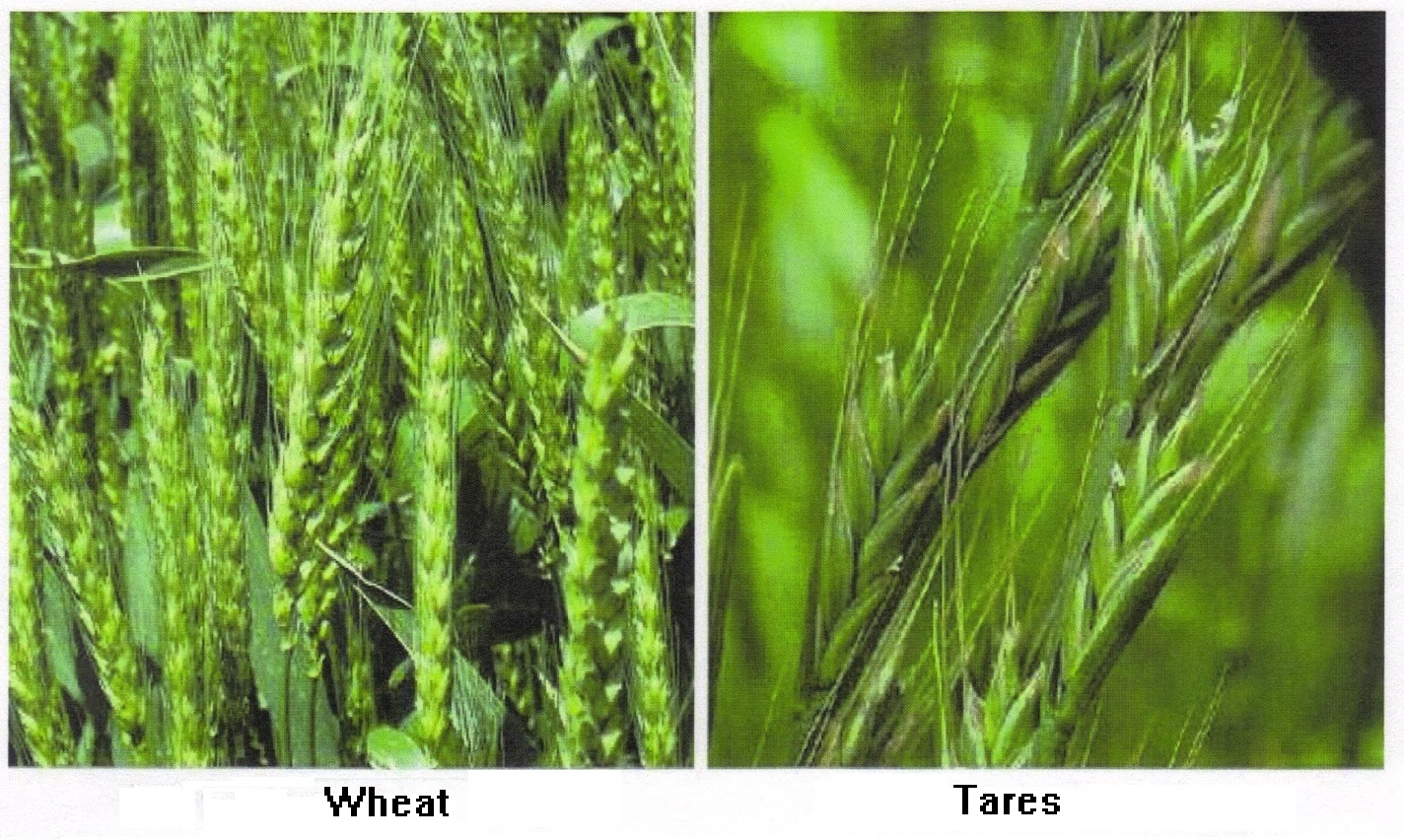
The servants want to go in and pull out the weeds, but how does the Master in the story respond? He advises his servants to let the weeds grow because if they were to pull out the weeds they would uproot the wheat as well. Consider this for a moment? Why would we want to let detrimental weeds grow in our lives? Why would it be unwise to go in a remove the unwanted plants from the fields? Jesus in essence is saying let people sin. Why would a righteous God who demands holiness allow the weeds to continue to grow?
Without untrained eyes it would be difficult to determine what is good and what is bad when it comes to wheat and rye. For most of us in this room, we could go into the field and we would not have any idea where to even begin. So we would begin to uproot plants, not knowing if we were pulling a weed or the crop. Even seasoned farmers often have a hard time distinguishing the difference until the plants have grown larger, because the differences in the early stages of the plant are almost microscopic. We must allow time to run its course.
This story is a good story. It tells us a great deal about good intentions and how we can cause great harm if we are not disciplined. If the servants of the master went out and began to uproot plants trying their hardest to make sure the harvest was good, they could very easily cause ruin. It is difficult to let things sit when you know something is wrong. It is hard for us to let seeds of grace mature without stepping in to try to pull out the seeds of evil in the lives of those we are serving. But we have to wait for the master to let us know when to act. It is not our harvest, but God’s. It is not our field that is being worked but His. We do not and cannot change the spiritual fields ourselves but must work with and under the direction of our master.
This requires us to become disciplined in our own lives. Working on little things in ourselves first and then encouraging others. We first need to follow the rhythm of life that Jesus showed us; a life where we make it our custom to worship, where we withdraw to the isolated places to pray, and then to go out into the fields to minister where the master has lead us. Without this rhythm we are unable to discern the voice of the master. Without this disciplined life we are unable to see the difference between the wheat and the weed. But even with this disciplined life we must be careful. A few months ago I spoke about the stages of belief: the first being knowledge, the second being trust, and the third being entrust. These stages of belief also play a role in how well we are able to handle the kingdom of heaven.
Those that act on knowledge, but without trust will often move forward without discernment and cause harm, even with good intentions. Those that fail to entrust their lives and the lives of others into the care of God, will often find that their lives may have uprooted the seeds of grace and are now nurturing plants with poisonous intoxicating properties. This is why the gospel writers included the spiritual practices of Jesus in their stories and why they included his parables alongside his miracles, so that we would be able move from one stage to the next.
So why do we wait to pull the weeds? Coming from an agricultural background I understand these agronomic parables better than some, and since I have a degree in crop science it helps as well. While studying for my degree, I actually had to take classes dealing with the study of soils, the study of crops, and the study of weeds. These classes were to train us in how to encourage the earth to produce as much as possible, how to choose which plants to grow where, and how to identify potential issues before they became a problem. I often thought that in becoming a pastor in an urban setting these skills I learned in school and on the farm might have been wasted but then I read scripture. Why does Jesus ask his servants to wait? Rye matures faster than wheat, so as the plants mature you can identify them and cut them out before the harvest of wheat begins. So when Jesus is telling us to wait to pull the weeds, he is telling us that if we wait we will see more clearly, we will nurture the good seeds and then the contrast between the good and bad become more visible.
Often those in the church fail to see the kingdom all around us because we are too focused on the weeds instead of focusing on the seeds of grace that God has called us to nurture. We see all that is wrong with the world, and want to act before God has had a chance to get the good seeds established. The problem with that type of view is we become our own worst enemy. We work hard to nurture the lives around us and then we begin pulling weeds and in the process uprooting the spiritual lives of the ones we are called to minister too. In our desires to groom righteous people we forget to teach discipline and stop the deeper establishment of belief. The kingdom of Heaven is all around us. The early friends would explain it as the spark of light in everyone, our job as followers and Friends of Christ is to nurture and feed the light, fertilize and water the seeds of belief until the hearts are a blaze and the flowers are in bloom. We do not see the kingdom around us because often we have stopped tending the fields.
As we enter into this time of open worship and communion as Friends let us consider the wheat and the weeds, let us consider the stages of belief and the rhythm of life that Jesus taught us. Let us look at how we can assist our master in his fields by nurturing the seeds he plants and let the angels cut out the rye that the evil one has planted to confuse and hinder us. And let us become people walking along with Jesus as he worships, prays, and serves those in his community; and become a people Loving God, Embracing the Holy Spirit, and Living the Love of Christ with other.
What? Did I just miss the point? (Sermon November 10, 2013)
Scripture: Luke 20:27-38
Have you ever been in a conversation with someone who tried to present themselves, as an expert in an area, but in reality know nothing about the topic? It is even worse when you happen to have an extensive knowledge in an area in which they speak but they seem to be unable to acknowledge their error. I have been in many of these conversations sometimes they can be very funny but in many cases they can quickly devolve into an argument because often people do not like to be corrected of their ignorance. Yes I use the term ignorance because that is what most of these discussions are, they are without proper knowledge and because of that they are presenting things improperly. And I willing admit that at times I am the ignorant person in some conversations.
I remember several conversations that I have had with people as I worked as an overnight sales floor associate, many of these conversations moved into the areas of what the Christian view is on many areas. In most of the cases the ignorance was a willful ignorance, meaning they had no desire to gain proper knowledge but would continue to spread their faulty ideas. This was most prevalent when the discussion was over the Christian response to Islam. I was often worried about the direction these discussions would take because I knew that most people involved were working with limited knowledge over the subject matter, on both sides. For example many of my Islamic friends were debating with the assumption that all Christians believed in three gods, those gods being the Father, Jesus the Son, and Mary. Many of the Christians were debating thinking that all Islamic groups were the same as well not realizing that there are two major groups. It got to the point that I actually asked one of my Islamic friends to read a book from which I gained what knowledge I had over their faith and asked them to let me know where the presentation was inaccurate. They actually jumped at the opportunity, which opened them up to asking questions as well about their ignorance of Christianity.
I would try to stay out of many of these discussions because a fool seems wise until they open their mouths, and I did not want to look the fool. Each side would gear up to debate, and to argue their points but neither would really listen to the other party. I had one friend that took me aside once and demanded that I prove my faith to him, saying, “If you prove that your faith is true I will convert.” What a great door opening up to me, I wanted to speak, but instead I said to him, “I will answer any questions you have about my faith and how my faith has changed my life, but I will not debate. Because there is nothing that I can say that could say in an argument that would convince you fully.” I left the conversation feeling that maybe I missed a great opportunity to encourage this man’s life, but I also felt that it was the correct answer to the situation. He did ask several questions over the course of our time working together, but I did not push. Eventually he told me that he was going to transfer but he enjoyed our discussions, he admitted to me that he did question many teaching of both religions and asked me if I had ever struggled. I was totally honest with him, telling him that yes I question my faith every day, I study and pray daily wanting to continually prove to myself that I am not just grasping wind. That is part of Christianity we can doubt, question, and seek answers. I told him that Jesus even encourages us to do these things. Which allowed me to tell him that in all my searching I always come back to the same thing I always come back to Jesus. This then opened a door for me to provide him some of the resources I used to come to my conclusions, he accepted the books that I offered and we went on our way.
Often times we want to prove that we are right. We will push forward in a debate with the goal to prove our points and actually miss the questions being asked. We in our attempts to win people for Christ can miss the point. That is what religion often does. Religion is a human attempt to explain or reach the divine. It is a human attempt. This means that in the attempt our explanation will by default be tinted by human experience and perspective. That perspective can be incorrect at any given point. I am not saying that it is wrong out right, but it may not tell the entire truth. Theology is a fascinating field of study because there are several different perspectives to explore, each opening a new window of light from which we can view the human interaction with God. The danger in theology and what has gotten all denominations in trouble is when they decide that their perspective of theology is correct and without error. I say that it is dangerous because that view assumes that we then have total knowledge of God and there is no longer any room to question.
This is where division enters communities. Last week many followers of Jesus in many traditions celebrated Reformation Day. It is a very important day because it prompted many people to again question what they say they believe, to seek answers and to find God. But along with that day it also started a battle between religious power structures that both claimed to have total truth, yet their views differed. It is a day that marks the division of Catholic and Protestant. It is a day of celebration and in the same breath a day of sorrow. There is not unity in the Church, there is not room for different ideas or perspectives, and in many ways we celebrate ignorance. In all of our arguments could we actually miss the point?
That is where we find Jesus in today’s passage. There is a group of people coming to him asking a theological question. In the New Testament we see the interaction between two schools of thought among the Jewish people the Pharisee viewpoint and that of the Sadducee. In many ways they believe the same things, the essentials are all there, the difference comes in the areas that are unclear in scripture. In this particular case it deals with marriage.
The question comes as to whom is the woman married to in the resurrection? That is the question presented but is that the real question asked? As I read this passage I sense a couple of extra questions; what is marriage, and what is resurrection are two that come to mind. The Sadducee, it states, does not believe in the resurrection from the dead, yet they ask this question, because there is an aspect of the extension of life that is unclear in scripture. Just by observation and in my own personal ignorance of ancient Jewish traditions I would say that the Sadducee understanding of resurrection would be in the physical linage or becoming parents. There was a reason that Moses wrote the law and if there are no children the question is was the life of these seven brothers in vain?
There is also a question of marriage. The law states that if a woman’s husband dies without a child the brother of the man must take the woman as his wife and bear children in the brother’s name. Is the point of marriage only in the bearing of children?
These are questions that the scholars and theologians of ancient times struggled with. Each group was certain that they had the correct answer to the presented question, but did they miss the entire point of question. Jesus begins to answer the question by saying, “those who belong to this age marry and are given in marriage; but those who are considered worthy of a place in that age in the resurrection from the dead neither marry nor are given in marriage.” Those worthy of that age do not marry, why? “Indeed they cannot die anymore, because they are like angels and are children of God, being children of the resurrection. And the fact that the dead are raised Moses himself showed, in the story about the bush, where he speaks of the Lord as the God of Abraham, the God of Isaac, and the God of Jacob. Now he is God not of the dead, but of the living; for to him all of them are alive.”
This speaks volumes about marriage, life, death, and resurrection. What is marriage? In the beginning God said that it was not good for man to be alone, so God created woman. The beginning point of marriage is that it is not good for mankind to be alone. That life is to be lived in relationship. Marriage first and foremost is friendship. The story goes on to say that Adam and Eve, our first parents, walked through the garden naked and unashamed. This also says that in relationship there is vulnerability, intimacy, and trust. No hiding, no secrets, just naked and unashamed. That kind of intimacy is difficult to obtain which is where God comes in.
We as humans are bound by fear. We live in the constant fear of being known. The fear is that if people were to know us deeply that we would be found lacking in some way. So we prop ourselves us sewing together ideas that become masks and walls. These masks and walls became the perspectives from which we relate to everyone around us. You fear and out of your fear, you judge me and everyone else around you in certain ways. We are either allies that can prop us our image or enemies to be marginalized. In our fear we live alone, we live contrary to the will of God, and are dead.
God is not the God of the dead but the living. You can only have relationships with the living. This brings to light the questions of life, death, and resurrection. The Lord is the God of Abraham, the God of Isaac, and the God of Jacob, Moses heard these statements centuries after these men died yet God was speaking about them not in the past tense but the present. When we are in relationship with God true life continues beyond our understanding of time. It is life then, now, and evermore. This cannot be explained adequately from a human perspective. For some it speaks of heritage as we have children or influence the lives of others our life continues with them. Others see it in a mystical spiritual perspective that is supernatural. People argue over the meaning but both could be equally correct or incorrect.
What does Jesus mean in his answer? Marriage is focused not on the legal aspects of matrimony but on the relational aspects of life together, joining together and proceeding through time not alone but as one unit. Life is not defined by the time between birth and burial but extends beyond the realm of time and space. So what do we know for sure? We do not know anything fully. At best we are ignorant because it is impossible to have full knowledge in the areas beyond our human senses. No matter what our best science and observations seem lacking. Even our greatest theologies can seem to have holes that we cannot fully explain. The point is that it is ok not to have all the answers, as long as we are willing to ask questions. It is ok to lack understanding as long as we do not build a wall around our ignorance. The main things is that Life is more important that being right. Life must be lived, honored, and protected. Does it matter whom the woman is married to? No it is that she was not alone. Our Lord is for the living and the living can only be seen and understood in our current human perspective. They are the people walking all around us. To participate in God’s life with others that should be our focus. It is not good for man to be alone. That is why God Himself came to live among mankind, to take on all the fear, shame, and death that separates us from true relationships, and to lift us up to His glory. Never more to be alone, but Emmanuel, God With Us.
In all of our debates and arguments let us not forget that one perspective. Does our stance protect and honor life? Does our theology leave room for the marginalized? Are we leaving people alone and without hope or are we sharing with them life with a living God?
He Is Risen! (Sermon March 31, 2013)
Scripture: John 20:1-18

Corcovado jesus (Photo credit: @Doug88888)
He is Risen! He is Risen indeed!
This one statement has been the most divisive phrase in all of history. What one believes about this phrase has the potential to affect their lives today and for ages to come. One phrase. This one phrase turned the most powerful empire of all time completely upside down. This one phrase divided a nation with an existence that traced its roots to the beginning of time. One phrase.
Words, phrases, ideas can affect how we observe life. They can inspire us to take action, or they can cause us retreat. Words can hold great power but only when there is something to back up the words. This one phrase “He is Risen!” is three simple words. These three words changed the course of history, not only for a small nearly insignificant costal province on the frontier of the Roman Empire, but it changed the course of history for every nation, race, and person that has ever encountered them. Because behind these three words hold within them the most dreadful or most inspiring truth. What one does with these three words changes everything. They can insight anger, inspire hope, cause confusion, or understanding. Three little words that cause us all to have to come up with an answer to the question, what happened to Jesus?
On the day we now call Good Friday Jesus was hung on a tree. He was put there because what he said threatened to disrupt the balance of power. For the religious leaders his words caused people to turn away from their teachings so they were losing their prestige and influence over others. They were losing the wealth people provided them through offerings and fees, their very livelihoods and status in the community were threatened. For the Romans, Jesus was a nuisance that threatened peace because many that followed him wanted to start a war for independence. This threatened the governor who was already under scrutiny by the Emperor not only because this province on the far eastern boarder of the empire was rebellious but also because this governor was recommended to the post by a person that was found to be a treasonous traitor. This governor did not want trouble, he wanted order and to keep order he would use whatever means necessary, even death. Even if he knew that the one condemned to die was an innocent man.
On the second day, all of Israel worshiped God as they celebrated their festival. But there were some that were not in a celebratory mood. The darkest day for mankind is Holy Saturday, the day that the hopeful king lay in a tomb. Darkness falls on the earth. The light of God dims and the revelation to man is snuffed out and sealed behind a rock. All hope is lost. They once cheered Jesus as their king yet quickly that celebration turned completely around, and now the king is buried. The religious leaders go on with their rituals; the roman leaders feast over a rebellion thwarted, and the followers of Jesus lock themselves behind closed doors.
This is where we find Mary on the third day; it is not a day of celebration for her. In her mind all is lost. The only thing left is to perform the customary ritual and seal her hope and salvation away. Not that long before she had seen this man walk up to the tomb of her brother and call him back from Abraham’s bosom into the light, yet this man who could heal the blind, cause the lame to walk, this man that could feed the multitude, and raised the dead is now laying on a rock slab wrapped in linen. The dreams of a king and a kingdom wrapped with him. It is truly a dark day.
She approaches the tomb; she approaches to mourn the loss of a dear friend. She approaches to say the customary prayers and rituals, but something is wrong. The stone that sealed the opening was moved. She stops knowing that this is not right and her day got even darker. Someone had opened the tomb. This is a very distressing thing that we often gloss over. The Hebrew culture does not take the desecration of graves lightly. I remember a few years in Wichita, a group of vandals enter the cemetery where the local Jewish population buried their loved ones and began to vandalize the grave markers. The resting place of their loved ones was disturbed and as a result the people of the community re-mourned the passing of each individual. They opened the graves and buried the vandalized stones, and place new markers. They again performed the funeral services for every disturbed grave. To disrupt the dead is painful for the community. There are customs to be upheld even if the person that has passed beyond the veil is seen as a criminal. Something was wrong the body was disturbed. So she runs to find the others.
Imagine the distress of Mary, of Peter, and the other disciple (the one Jesus loved). What could have possibly happened? Who would have been so disrespectful to disturb the body of their friend, a friend that was executed in a way contrary to their laws? They ran to the tomb, they ran as if their very life depended on getting to it as soon as possible. And they find a mystery. The body is gone but the grave clothes were still there.
This is a mystery because the grave clothes are not exactly easy to remove. When Jesus called out to Lazarus, Mary’s brother, who was dead and buried for four days he was bound hand and foot in the grave clothes. These were strips of cloth soaked in myrrh, aloes, and spices. They were tightly wrapped and stitched up so that the body could be contained for a later ceremony when the bones were moved into bone boxes.
There is another oddity the cloth that had been on Jesus’ head was not lying with the linen wrappings but rolled up in a place by itself. This cloth was Jesus’ Tallit or his prayer shawl. This is a very important piece of cloth; its literal meaning is little tent, it represents the idea that all of Israel cannot enter into the tent of meeting so they each enter their own little tent as they near the tent to worship. It is used to cover their heads when they pray, which forms the prayer closet that Jesus referred too in his teachings. Under this little tent a couple is united in marriage. This Tallit is placed over the body when it is buried because it is where the man’s connection to God happens. This Tallit was placed away from the burial clothes and carefully put to one side.
If you saw this what would be going through your mind? The clothes were empty but undisturbed the stitching still intact. The prayer shawl, Jesus’ prayer shawl, which they had seen every day for the past three years, was carefully and respectfully folded as if used and then laid down. John saw this mystery and believed but what was it that he believed?
He is risen? What would it take for you to believe? The disciples though they heard what Jesus had taught did not fully grasp the meaning of what was happening. It was a mystery. Why was the shawl laying separate? Why was it not taken with the body, if the body was taken? Who would take the body and why would they want to? Nothing made since. Mary stood outside the tomb weeping because in desperation and sorrow that is really the only thing a person can do well. She bent down and looked inside the tomb, and she saw something amazing. She saw two angels and they asked, “Why do you weep?” Imagine that. She just saw the two disciples enter and leave and no one else yet here are two beings just standing there. She told them her sorrows and then she turned away only to see a man standing behind her. He too asks, “Why do you weep?” Mary again tells the same story, explaining why she is so full of sorrow. She had lost everything; her entire life was devoted to Jesus now she cannot even visit the body. She turns away again and Jesus looks at her and calls to her by name. “Mary!”
He is Risen! What would it take for you to believe? What would that belief cause to happen if you truly lived as if you believed? It took one word for Mary. It took one little tent for John. What would it cause in your life if you truly believed? For Mary in a split second her tears of sorrow were dried up as she screams in sheer joy “Rabbouni!” In a moment John knew that, the relationship between God and man had changed. The tent of meeting, the prayer closet, or the shawl that was representative of the place where God could meet with mankind was laid aside and God was with us.
He is Risen! In a moment the darkness of Saturday has passed into light. Hope has been restored into something beyond our wildest dreams. The bonds of death cannot hold him. And God is with us! What will it take for you to believe in your own life?
For me it took a baby in my arms. That belief continued when I was lead to go to Ukraine. I did not have enough money to go on my own yet in a couple short months I was on a plane heading over the ocean. That belief continued to grow when a guy who stuttered when nervous and would rarely speak in private let alone in public lead classes of a hundred students and spoke freely. It continued to grow as God gave words to speak and began to call me to teach and preach. That belief brought me here to Kansas City and I am seeing that power of the Risen Christ working all around me. Have I experienced a miracle? I do not know, but what I do know is that the love of God took a guy heading into a life of hopelessness and gave him something greater. It began and it grew, it has empowered and it has shown me things I never thought I would see. What would it take for you?
He is Risen! Death could not hold Him in its clothes and the tent could not contain his glory. He came bursting out of tomb moving that stone of separation and he spoke to the sorrowful woman that lost her greatest friend. He inspired the disciple to experience God in a brand new way. He called a sinful, shy, stuttering man to preach His gospel. What will it take for you to seek Him as not only a teacher but also a friend, not only as a far off story of ages past but a current reality?
Jesus took on our humanity in every form: He lived a complete life for us and with us as He was conceived by the Holy Spirit, born of the Virgin Mary, He grew up experiencing childhood and adolescence, He had a career and he left that career to minister. He lived a life of prayer, worship, and ministry as He withdrew to solitary places, made it His custom to meet at the synagogues, and healed many diseases. He sat down and spoke with the Samaritan women who lived a life of divorce and cohabitation, He did not condemn the one caught in adultery, and He touched the leapers and made them clean. He got angry over injustice and He wept for His friends and his nation. He gave His life for us because we would rather justify our own actions instead of truly living for with God, and He lay in that tomb that place removed from all life and love, dead. But death could not keep Him bound.
He knows our sorrow, our pain, our temptations, and He overcame them for us and through His life, death, burial and resurrection He offers us a new life and restored hope. He is risen! What will it take for us to believe? And what will happen if we lived as if we really believed that He is risen indeed?