Jwquaker's Blog
missional church
Hearing the Spirit and find the Rock (Sermon August 24, 2014)
Matthew 16:13–20 (NRSV)
Peter’s Declaration about Jesus
(Mk 8:27–30; Lk 9:18–20)
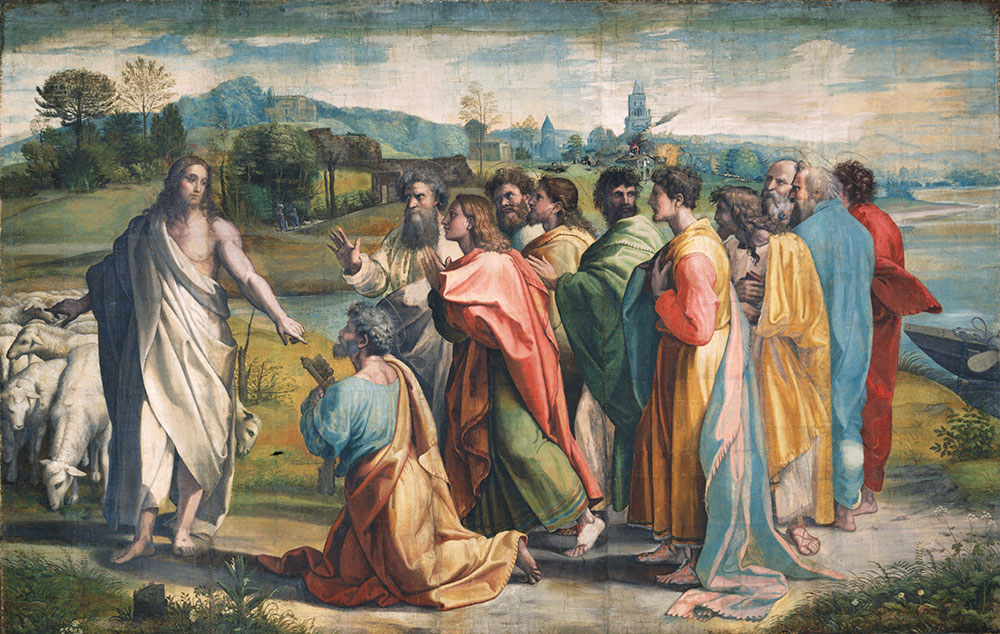
Raphael, 1515-1516
Victoria and Albert Museum, London, Great Britain
13 Now when Jesus came into the district of Caesarea Philippi, he asked his disciples, “Who do people say that the Son of Man is?” 14 And they said, “Some say John the Baptist, but others Elijah, and still others Jeremiah or one of the prophets.” 15 He said to them, “But who do you say that I am?” 16 Simon Peter answered, “You are the Messiah, the Son of the living God.” 17 And Jesus answered him, “Blessed are you, Simon son of Jonah! For flesh and blood has not revealed this to you, but my Father in heaven. 18 And I tell you, you are Peter, and on this rock I will build my church, and the gates of Hades will not prevail against it. 19 I will give you the keys of the kingdom of heaven, and whatever you bind on earth will be bound in heaven, and whatever you loose on earth will be loosed in heaven.” 20 Then he sternly ordered the disciples not to tell anyone that he was the Messiah.
How often do we take the time to really consider how we got to the place that we are? I know it is an odd question and probably not one that many of us even want to consider, but so often our culture wants us to forget about cause and effect. If you eat fast food everyday chances are you are going to have serious health problems in the future. If you sit all day at a computer your body will develop odd configurations of your bones. There are always cause and effect relationships. I want us to consider these relationships as we reflect on this passage today.
Jesus has gone to the northern part of what we call Israel to a town named after the emperor of Rome and the son of Herod the great. Caesarea Philippi is a very interesting place. It is a deeply religious place, it was one of the centers of Baal worship, and was also a major center for the worship of the Greek god Pan. The town was one that had been renamed multiple times but the interesting thing about the name is that it has a similar theme: Baal-Gad or Hermon, Paneas, Caesarea Philippi, and even the current name Baneas all point to the worship of a god that is not the God of the Hebrew people. But there is still a connection.
This city is at the base of mount Hermon which is important in history because this is the place where after the Generals of Alexander the Great divided the Greek Empire the Egyptian branch and Persian branch fought over what we know as Israel, and Antiochus III defeated Ptolemies (the Egyptian ruler) and allowed the Jewish people to freely immigrate back to the land of their ancestors. Antiochus the great was a friend of the Jewish people, but his son Antiochus IV was the one that desecrated the temple which started the rebellion and subsequent independence of Israel under the Hasmonean Dynasty. It was at this Mount courses of history began.
But there is more this mountain has a cave with a large body of water inside, a pool of water that was seen as a gateway into the underworld because it was so deep and dark one could not begin to imagine where it ended, and this pool of water is considered one of the sources of the river Jordan.
So here at the source of the Jordan, the very river that was used to initiate the ministry of Jesus, at the site of one of the largest and most active pagan shrines Jesus asks his disciples to examine themselves and their understanding of who He is. At this cultural cross road they are challenged. “Who do they say that I am?”
This discourse between Jesus and his disciples beginning of a new era, it is the start of the next chapter of the history of faith. “Who do they say I am?” and “Who do you say that I am.” The question was asked not in Jerusalem or even in Judea, but on the very northern border of Israel nearly outside of the land of their ancestors, laying in the disputed area between Lebanon, Syria, and Israel known as the Golan Heights. Even today this is a historical and cultural crossroad.
But now I want to jump forward and consider the response to the question. The apostle we know as Peter responded, “You are the Messiah, the son of the Living God.” This response has great value, not only does it establish that the disciples were beginning to understand that Jesus was more than just a Rabbi, it was also developing a newer understanding of the very nature of God. It is here that Jesus then gives Simon his second name Peter. But the explanation of this name change is what is most interesting.
“Blessed are you, Simon son of Jonah! For flesh and blood has not revealed this to you, but my Father in heaven. 18 And I tell you, you are Peter, and on this rock I will build my church…” There are several things happening here. First though we need to understand why Jesus gave him a new name to begin with. In many ancient cultures, especially the Hebrew culture a name carries great meaning. The meaning of the name is often a prophetic declaration of the individual. There are three names mentioned in this response by Jesus: Simon, Jonah, and Peter. Each name has significant meaning. Simon means, “He has heard”.
He has heard, what a prophetic name for one of the disciples that heard and listened to the calling of Jesus to follow. It was Simon that basically took the leadership role of the apostles. He has heard. Along with hearing comes the more active form of listening. So not only does Simon hear, but he listens.
The second name is Jonah. Jonah is an interesting name because it could mean two very different things. In most cases it means dove. The dove was used in the worship at the temple, and has long been associated in the church as the symbol of the Holy Spirit, mainly because that was the visual imagery used in describing the spirit deciding on Jesus. But Jonah also has a negative connotation to it. Hebrew is a language where the written form does not use vowels, so the reader must insert them in their mind, so depending on the usage the written form of a word can take on a totally different meaning. In the case of Jonah, dove or the bringer of grace through sacrifice, or it could also mean to vex, or oppress. So this name could be a blessing or a curse.
The third name is Peter which means stone. Now this is where it get interesting. Because Peter or Petros is not the type of rock that you would build a building out of, it is a fragile fragment of a rock. But the feminine form of the word, Petra is solid and is the type of rock that builders and artists would want to have access too. Petra is the word used for what the church is going to be built, but Petros is the name. Again both negative and positive aspects, and a prophetic message in both depending on which path one was to take.
So the message in the names can mean two things: 1. He hears and is vexed and crumbles, or 2. He hears the spirit and builds on a firm rock. The question Jesus asks again, “who do you say that I am.”
Jesus is standing there on the crossroads of culture, history, and faith and he is laying it out all out before them. They are saying things about me and you are saying things too, which are you going to believe? I mention this because we have all stood at a place very similar to this in our lives. We have faced a challenge and the decision that we would make at that moment would direct the course of our lives. How do we move forward, how do we see through the vexations and the blessings?
“Who do you say that I am?” Jesus is still asking that question to every person in every age. There are many answers to this question, and with each answer comes a very different path. There are those that say that Jesus is just a myth, a hopeful figment of the imagination of broken people. That answer will set a course in life. A course where the only strength available to you is what you personally possess. The problem with that is the constant erosion that is presented in the various aspects of life. Although you have the freedom to choose whatever you want to do with no bonds most that choose this path become bitter and broken people. They are hard to love because they have been hurt deeply by relationships and have no one to turn to but their own fragile stones.
Then there are those that equate Jesus to a good moral teacher, these people will often hear the teaching of Jesus and find them very appealing but are often swayed by other teachings that sound just as good. To them, Jesus is no different than any other religious founder, just a man with a good message. The path they tread is a bit more solid because they now have a moral guide that will help them deal with the struggles of life, but still they must rely only on their own strength.
Then there are those that believe as Simon Peter, “you are the Messiah, the son of the Living God.” Those that say this are set on a different course, one that does not rely on their strength but the collective strength of those in their community and in their weakness they have faith that God will provide the necessary power to overcome.
It sounds so simple in word, but in reality we all move up and down this spectrum with each major decision we face. With each there is a form of belief but only one is the type of belief that we are able to see the hand of God moving. We reach these crossroads and we choose. Will I move forward in myself, will I trust the ways of our spiritual forefathers, or will I step out and entrust all I have to God. How do we move forward, how do we move beyond into greater trust and belief?
Through listening. This is where Jesus will build his church. It is on those that will look beyond the worldly wisdoms, the moral codes of centuries of dogma, and will simply listen and follow. This is why Jesus came to live a full life, from prenatal existence, through childhood and on into adulthood. This is why he showed his disciples the holy rhythm of life of worship, prayer, and service. Because it is in that rhythm we can begin to listen and respond. It is in that rhythm where we make it our custom to join together in worship to encourage each other and praise God that we find the strength to take deeper steps into faith. When we withdraw to the isolated places to pray, we remove ourselves from the chaos of the world and can center down and hear the voice of God teaching, encouraging and calling us to action. And it is in service that our faith is tested and the fragile pebbles of our life are pressed into beautiful stone fit for building. Then the cycle begins again, because the testing of our faith and the pressure of service can discourage us so we go back into worship to have our community join with us to encourage once again, it is through our prayers in the isolated places where we again are called, and we are provided with the strength to minister once again.
It is that rhythm that is the key to the kingdom. It is that lifestyle of Jesus that the church is built. Because it is in that holy rhythm of devotion that reaches out the people marginalized by the world, leading defeated bitter lives. But the question still remains, “Who do you say that I am?” How we answer that question will determine how we approach the calling God is giving us. If we honestly say that He is the Messiah, the Son of the Living God, then we have access to the power that create out of nothing, and can use the insignificant to bring about the amazing. Who do you say He is?
As we enter into this time of open worship and holy expectancy, I want us each to examine our lives just for a bit, consider the choices that we have made in the past that have led us to where we are today, and ask God to reveal to us where and who our faith was in? Then I want us to imagine the future, where is God calling us? Are we hearing the voice of the spirit leading us to solid rock or are we being vexed by our own desires and standing on fragile stone?
Working the Soils (Sermon July 13, 2014)
Scripture: Matthew 13:1-9, 18-23
There is something powerful about a story. Stories have a strange power that can transport us from one place and time in to a totally different universe. This is why so many of us enjoy a good book or movie, those stories take us from our living rooms and transport us to worlds far in the future, or deep into history. A good story often has a theme that encourages us in some way. There is usually an obstacle of some sort that the main character must overcome. Or there may be some sort of ethical issue in which the story teller is prompting us to consider through the facilities of imagination. This is why some of the greatest teaching Jesus has are not in the explanation of scriptures, but the seemingly entertaining metaphorical stories he tells.
The seeds, it is a story that we have each listened to so often that I wonder if we really listen to it any more. But imagine you had not heard it. You came to the seaside to listen to this traveling teacher and the crowd is so large that to be heard the teacher gets onto a boat and floats out a ways using the terrain as a natural amphitheater. You are anticipating the message you are about to hear, and you are hoping that you will be able to see a miracle.
Jesus looks out at the crowd and begins to speak. There was a farmer that was scattering seeds, the seeds fell in various different places. Some fell on the path where the birds came and ate them, others fell in rocky soil and grew rapidly but quickly withered. Some of the seeds fell among the weeds and were choked out and others fell on good soils and produced an abundance. Then he looks out at the crowd again, says “Let anyone with ears listen,” and he sits down in the boat. The teaching is over because he has now turned his attention away from the crowd and is focused only on his closest followers.
Consider that for a moment. That was the entire sermon that Jesus gave at that moment. No further explanation, no deeper discussion explaining the metaphors to the masses, He simply told a story and left it hanging there in the air. Concluding by saying “Let anyone with ears listen.”
Often we think a story is just entertaining and fun, but often the deepest and most meaningful expressions of faith come from the simplest stories. These simple stories of overcoming obstacles and finding a pathway through a struggle our culture yearns for from the deepest parts of their beings. This is something that humanity has always loved. The story of your life is one of the most powerful things this world has ever heard. The story of how you struggle and found hope even in the darkness, is often a balm for the wounded hearts attached to listening ears.
The sower and the seeds. For many of us is a simple story of a farmer, but in ancient times it was not as simple as we might think. Notice the first illustration that Jesus uses, “Some seed fell on the path, and the birds came and ate them up.” The words used in this phrase to a listening ear is packed full of spiritual imagery. Although some birds were used as symbols of grace, and used in temple worship, birds were often seen as robbers in the culture. When a farmer had an infestation of birds their livelihood was stolen from them. As Jesus explains later to his disciples, the path is a heart that has been hardened so even though grace and mercy is scattered over that heart the hearer of the words do not sense it. Quickly the minions of evil rob that person of the words of life before the grace even has a chance to germinate. To go a bit deep the phrase, “ate them up,” is a term that is also used for devour, exploit, or to take advantage of. If we were to consider that for a moment we get a very different picture of these hardened people.
A path is a place where foot traffic has compacted the soil. A hardened heart is a heart that has been exploited and used, it is a person that has been abused by its culture so long that it resists any and all mercy. We each know these types of people, when you talk to them they are immediately skeptical and pessimistic.
Jesus continues, “Other seeds fell on the rocky ground, where they did not have much soil…” Rocky soil is a soil of transition, it is either in the process of being trampled and packed or nurtured to become productive. There is something there that responds to the seeds of grace, but Jesus says the sun comes out and they wither because they have no root. These rocky hearts are extremely vulnerable. They often respond to encouragement but can also be quickly turned away. I fear for these types of individuals, because often they can get caught up in the emotionalism of a moment but when their life experiences do not meet their expectations they can quickly become hard.
For example I was in a conversation with a leader of another denomination, this particular leader made an observation that there was a great deal of turnover in leadership among their group and he was reaching out to other Christian leaders for advice. This particular group was one that based the majority of their teaching on excitement, emotions, and blessing. In this leader’s group they would have leaders rise and fall away within a couple of months, leaving him questioning why. Groups like this are vulnerable to the rocky soil believers, they get excited about ministry and life with God and as long as there is not any struggle in their life, they continue to participate, but as soon as they encounter a difficulty they question everything about their faith. They enter into pastoral leadership, but they run into financial difficulties and resign, they begin to lead bible studies but then they have marital struggles and suddenly they question if God even exists. Many of these people then become hardened to the gospel because they tried it once and it did not work, they tried God and He did not bless them and in many cases they left in worse shape than they began.
Jesus continues to speak about the seeds that fell among the thorns and were choked. These are lives that are filled with various worries and distractions. Lives that have so many demands on time and attention that there is no room for anything else. These people by in large are good people, these people if you were to ask them actually say that they believe in God, but they are just unable to grow in their faith because the soils of their life are filled with other things. Our culture by in large is filled with people like this. We are a busy people. We juggle multiple jobs and our family. We have debts that need repaid and mouths to feed, even when we have a few hours to relax we fill that time with things that are equally as demanding as everything else. We like the idea of God, but a relationship with God is just something that will have to wait.
Jesus is teaching to people that understand agriculture. Those listening to this story, if they themselves are not a farmer, know someone who is. They have each observed each of these sorts of situations. They experienced birds robbing them of crops by eating the seeds, they have seen plants quickly taking off and withering away as the temperature rises, and they have seen the weeds choke out the plants that they hoped would feed their families. They also know that the earth is constantly changing and that with proper and intentional care any field can become productive.
Often when we listen to this story we look at it from a position that all soils and all people will not or cannot change. That is not the case. Good soils can become bad and poor soils can become good if we work with them according to their specific needs. So we must then consider what we as ministers of the Gospel of Jesus should do to prepare lives for the seeds of grace? The goal of our efforts is to harvest of the planted seeds. We first keep that goal in mind, but we also have to recognize the situations around us. Jesus is saying to these listening ears in this simple story, that just like a farm a relationship with God takes a lot of work. This is the reason Jesus came to live among us, to show us how to tend the fields of life. It is through the life that has joined into the spiritual rhythm of Jesus’ example that we are able to tend the fields of our community. The rhythm of worship, prayer, and service are similar to the efforts a farm employs in the fields.
The work first begins in our own lives, because we cannot share with others what we ourselves do not possess. When we enter into the spiritual rhythm Jesus has shown, we remove the weeds as we learn through worship and prayer what areas of our own lives can be simplified, and as we simplify our lives we can then encourage others to simplify theirs as well. When we intentionally make time to pray we quickly recognize all the things that are making demands on our time, examine those demands and weed out the ones that are distracting us from the goal of a harvest.
We also may observe not only weeds but rocky areas that prevent deepening roots, things that may threaten our very faith. What do we do to remove these rocks? Rocky soils are everywhere on earth. Ireland is considered to be the Emerald Isle, but the field though rich were also filled with rocks left buried after the glaciers of the Ice age receded from the land. For the farmers in Ireland to use the land to grow crops they had to dig into the ground and pull these rocks out, and they would then carry them to the edge of the field and stack them up. Eventually they removed so many rocks they build walls between the fields, walls that have become monuments to the persistence and dedication of man to survive. In our lives rocks could be many things. They can be addictions or choices that we may not be able to overcome on our own. This is where the church is so important, because it is in the church where we find others that have had similar issues and are willing to help us dig and carry the stones to build monuments of grace. To remove the rocks from the soils of our community requires the Disciples of Christ to become vulnerable and open to others. We become willing to share the areas of life that we have struggled and are willing to help others if asked. It also requires us to be willing to ask for help when we see a need in our own lives.
Prayer and worship assist us in removing the weeds and the rocks of our lives, but it also opens our eyes to be able to see the areas of our community where the seeds of grace are being devoured by the wild birds of the evil one. In the spiritual rhythm Jesus taught and showed us that worship and prayer leads us into service and ministry to the ones least in the community. These are the people that have been exploited and trampled and are so hardened in life that they cannot even begin to contemplate God. But hard soils can be remedied. It requires us to get out into the community to constantly work the soil, using the gifts and tools that God has given us to feed the hungry, clothe the naked, and help cleanse the ones that are unable to help themselves. These are the ones that will despise us and persecute us but they do that because they have hardness in their hearts and the grace and love of God is being snatch away before they have a chance. To break through the hardest soils requires time and work. Breaking up the soil in to chunks and then letting water seep in, then as it dries up you work it again until you get just enough soil that the seeds of grace can begin to take root.
It is those hard areas God wants us to labor. These are the ones God is calling us to share our lives and our stories to. Those are the ones we invest our time into, and expend our gifts. Working back and forth, up and down, always laboring even if we never seem to see any results. Then suddenly after a while we may see little glimmers of hope, and little shoots emerging in the cracks.
Let anyone with ears listen. Each of us have areas of hardness and areas of goodness. There are areas in our lives where the seeds of grace rapidly take hold and wither away and areas where they yield much fruit. Let us not forget that there is always room to improve. Let us not neglect our own spiritual lives and allow the weeds to encroach on us and begin to choke out our life. And let us be willing to engage our community even though we may face persecution of various types. Working in those hard areas showing and living the love of Christ even among those whose lives have been trampled and exploited in various ways. Soils change, and Christ is calling us to labor in His fields. Getting into the fields to pull the weeds, dig out the rocks, and break down the hardened pathways.
As we enter into a time of open worship and communion as Friends, let us examine our lives and identify the rocks and weeds keeping us from enjoying the abundant life in Christ. Let us also be open to the Spirit’s leading and see where God may want us to focus our time and talents in the lives of the least in our community. Let us have ears to listen.
Go and Make (Sermon June 15, 2014)
Scripture: Matthew 28:16-20
What is the purpose of the gathering of the church? This question is asked often as cultures shift and one era of history emerges into another. This is the question that many today are asking as well. Today several different expressions of the church are gaining more ground and followings. There is the missional church, which focuses on ministry outside of the church walls providing service to the community where you are and putting little emphasis on the meeting house. Then there is the emergent church that is seen as a blending of various spiritual and theological practices both ancient and contemporary. This emergent church is one that focuses mainly on providing spiritual experiences that will urge people into a deeper devotion to Christ. Then the last exciting concept emerging in the contemporary church is the new monasticism, communities are being built and orders are being formed that focus on continual and constant prayer.
What each of these movements show is that something has happened within the culture around us where what was once seen as being the primary method of ministry seems to be ineffective. The people of the world are closing themselves off from the gospel and it is becoming increasingly more difficult to reach out to those struggling in life with the hope we have in Jesus. Our culture has shifted from attending worship services weekly to something much deeper. Those outside the church no longer see value in attending church because the church seems to have become comfortable with itself and its place in society, no longer is it a force of hope and change but is often seen as an instrument of oppression and exclusion. Each of the contemporary movements have similarities, they notice that the church needs to address certain traditions that have become commonplace and revitalise them. The missional movement revitalizes the evangelistic mission of goo g to all the nations, which must first begin at home before we can become effective in the world. The emergent movement addresses worship practices and theologies and attempts to bring light back into the meeting for worship. And the new monastic movements encourage prayer, not just in the intercessory manner but deep contemplative and relational prayer. This is one of the most exciting times of the church because church and being a Christian is becoming something much different these movements require each person to become more active, no longer can one just be a spectator bit your faith must become a lifestyle.
I know that none of this is new. This is what church has always been but at times the meetings get lukewarm. Throughout history the church has gone through periods like these, and a new movement emerges to revitalize the church. But it goes deeper into history than just the 2000 odd years of our current era. The Jewish history also has cycles great devotion, complacency, and a reemergence. We can read about this throughout the old testament and in the oracles of the prophets. It is in one of these cycles where Christ comes and the church is built. The church as we know it has its roots going back to the beginning of time, yet in each age it has had to recalibrate to encourage each generation into a deeper relationship with God.
This is where we find the disciples in today’s passage. The church is in its infancy and is nearly getting its feet under them to begin to move without the assistance of a physical lord before them. This setting is just prior to the ascension, they meet together on a mountain which Jesus called them to, and they are in a state of awe and doubt. Jesus meets them when they see Him they begin to worship Him. They worshiped him, they provided Jesus with an honor only allowed to be performed in the temple, yet here they gave it to Jesus. In the midst of this honor, Jesus tells them, “All authority in heaven and on earth has been given to me.”
All authority, do we understand what this implies? To most of us it means that Jesus, has been given authority to rule,, jurisdiction, and power, but it can also mean freedom to act. All freedom to act in heaven and on earth. That is an interesting concept, not only does he have the power and ability to rule but he has all freedom to act upon what is necessary. Jesus demonstrated this authority in many ways as he lived and ministered in Galilee and Judea. What is important is that by Jesus say the words, “Go therefore,” Jesus is transferring the authority he has to his followers, sending them out in His name. When someone with that type of authority sends someone out in their name they have the exact authority as the one that sends them.
So Jesus sends them out under his authority and says, “Go therefore and make disciples of all nations…” First off we need to look at what is meant by the term nations. A nation is a people or a large group based on various cultural, physical or geographic ties. It can also refer to heathens, pagan, or Gentiles. Jesus is sending them out to all people, including all the heathens, pagans, Gentiles, and Jews. All the nations that is pretty hard to imagine. The apostles were given this task with authority passed down to them by Jesus himself, and that authority and mission has been passed down to each one of us because all the nations have yet to be reached. This is a task that will last through ages and ages to come. With each new birth of a child it extends the mission of Jesus Christ. With each new cultural shift and change we as agents of Jesus are given the freedom to go therefore and minister among them. We often get caught in the trap of thinking that the mission is over and that the culture is in decay leaving us to just wait around until the day that Christ is to return, but that is not what we are called to do, “Go therefore and make disciples of all the nations.”
We are called to go to all the nations and among that call we are to make disciples. A disciple is a student of a master. It goes beyond just believing that something is true, like I was saying a couple of weeks ago there are different levels of belief. The first is knowledge, the second is trust and the third is to entrust. Disciples are people that have moved along that path past the knowledge stage and are in the process of moving from trust to entrust. I say this because to be a disciple you must walk along the path of the master, one cannot walk that path until they have moved into some form of trust. The term disciple is a committed student. In the first century a disciple of a particular rabbi would leave everything and begin to walk where their teacher walked, eat what their teacher ate, they would imitate everything their teacher did until they themselves were equal to their teacher and could lead their own students. To be a disciple requires one to leave their current direction in life and to become totally committed living for and with their master or teacher. Often we try to soften the cost of discipleship make it easier in some way so that there can be greater growth among the followers. At other times we make even more rules so that only the very best can enter into the ranks. These are the very things that have prompted every reform of faith within the people of God, this swinging from one end of the spectrum to the other. At one point there is a focus on strict adherence to the law at other times it is free grace for all. Both of these are not telling the whole truth these reforms are only looking at the outward expression but discipleship holistic. Discipleship deals with the mind, body, and spirit. The goal of discipleship is to change the entire person and form them into something better.
Jesus sends his closest friends out saying, “Go therefore and make disciples of all the nations…” leaving us with a logical question, how? This is where the various denominations make their splits. Most real differences are about how we train and encourage people along the path of faith. We use different tools, examples, and experiences to encourage a person to take the steps through the process of true belief. Jesus tells us how to make disciples when he continues to speak, “…baptizing them in the name of the Father and of the Son and of the Holy Spirit…” Makes total sense right? When we read these words every one of us had something go through our mind as to what this means. For many when the word baptize is mentioned we immediately begin to imagine a religious ceremony of either a baby having their head rinsed by a priest, or a repentant person being plunged beneath the water’s surface. We each have a theological stance on which if any are correct, but in those many years of tradition the meaning has somewhat lost the power. We can pull parallels from the ancient hebrew practices of ritualistic cleansings and show how those traditions are passed on to the church by Jesus, and we can even look back in to the very beginning of Jesus’ public ministry and see John the Baptist performing this ritual in the Jordan, but often we fail to recognize that these rituals were just a shadow or illustration to what Jesus and John for that matter were trying to express. The term Baptize is to immerse or saturate and it was not used in a religious context until John the Baptist used it, prior to that and even well beyond it was a term used for the dyeing for fabrics.
To baptize someone is to dye them so that they no longer look the same but have a permanent and beautiful stain. One that dyes must totally immerse the fabric into the solution and let it sit for a portion of time and then remove the fabric and rinse it. It is a time consuming process in conditions that are not exactly ideal, the dyes smell funny and at times can even cause harm to the ones doing the work, but the end product is a beautiful fabric with uniform color throughout. The fabric is transformed into something of greater value. When John the Baptist cried out in the wilderness to repent and be baptized he was not just saying be washed but be transformed, even he said that what he was doing was not complete but the one that was to come after him would come with the true baptism. This true baptism is to take on the color or essence of Christ, so that every aspect of our being is touched and shaded in the hues of Jesus. To be baptised is to be immersed in the very life of Jesus, letting it saturate and color every aspect of our being until we are totally reflecting that that is Jesus. Consider that for a moment. We are dyed with Christ. Washed in the blood of Jesus takes on a totally different meaning. Saturated and colored by the very blood shed for us.
Blood is a connective tissue that flows through every part of our bodies. It connects and nourishes every system and function we need to survive. Blood is a great illustration for what it means to be baptized in the Name of the Father and of the Son and of the Holy Spirit, because blood saturates and connects everything that makes us live. This is what discipleship is, it is allowing the spirit of God to saturate every facet of our being. If blood does not get to a certain part of our body that area almost immediately begins to die, the coloring of the tissue begins to change and then the systems around them begin to shut down. The result is numbness or pain, or even sever cases the loss of an organ or life. To be a disciple to be baptized is to have every aspect of our being totally saturated with the God.
“Go therefore and make disciples of all nations, baptizing them in the name of the Father and of the Son and of the Holy Spirit, and teaching them to obey everything that I have commanded you.” We baptize by the act or the participation in the teaching of Jesus. Jesus taught with more than mere words, and the light he showed us was for more than just the afterlife. Jesus’ teaching was a lifestyle. It was a rhythm of living. It a balance of worship, prayer, and service to others. It involved discussions and the passing on of knowledge, but most of what he taught was in action. He would often use the service he provided to others as a means to express a deeper meaning or understanding of life with God. But it was the life of Jesus that is important in disciple making. He lived among us. He ate among us, He worshiped with those around Him and he showed us how to deepen and maintain a relationship with God. He saturated every aspect of humanity with His divine presence. He demonstrated how to work and honor God in it. He showed us how to honor God in our celebrations, feasting, and interaction with other. He taught and he demonstrated with his life. That is what Jesus is calling us to do. To go to all nations, all people, races, genders, heathens, pagans, people that don’t believe and people that believe differently and live a life saturated by God among those people, teaching them in our words and deeds. Walking with them as we go and helping when we can. Jesus has given us the freedom to act with his authority in these areas.
This is why the contemporary emerging movements of the church are so important. They are challenging us all to reconsider various aspects of our lives and our activities to see if we are actually making disciples or if we are just trying to fill the meeting houses. The Missional movement is challenging us by asking us if we are actually Going. The emergent network is asking us if we are actually following his teachings by questioning and experimenting with different techniques. The new monastics are challenging us to actually look at our lives and see if we are devoted completely. We could sit back and complain that maybe they do not have sound theology or that they attempt ministries without being prepared. We may even consider them lazy, and wish they got real jobs. But they are attempting to advance the church, they are attempting to make disciples of people many would like to over look. They are challenging us to become the church again.
God is working among us, he is calling us into ministries that may be uncomfortable at this time, but how will we respond? Will we saturate those God brings us to with the essence of Christ, will they be able to see that we ourselves have been saturated in Him? Will we be willing to walk and do what Jesus calls us to do here in our community?
I want to revisit the illustration of dyed fabric. Not all fabric is suitable for all things. People are different as well. We are not called to make copies of ourselves in all nations, but disciples of Jesus. We do not control what the final outcome will be for anyone, some will be called to preaching, others to teaching, some to giving and others to hospitality, some to heal and others to organize. These things are called Gifts of the spirit, meaning God gives them these Gifts not us. God has sent us out to make disciples and to baptize or to saturate and dye the people in the name of the triune God, but God is still in control of what they become in Him. Today is Father’s day and I want to acknowledge those men that have been instrumental in discipleship of my life. Often our parents are the first and most important influences of our lives that will set us on the course to God, but our parents do not control our destiny. My father, both of my fathers, taught me through words and actions. I saw them pray and worship, I saw them help others in need, I learned from my father the importance of giving to God first. My grandfather would often encourage me to look at things from a different perspective. My great Uncle taught me to never judge before you hear the whole story. These men in my life were saturated in the love of God, they lived it in every aspect of their lives, and they encouraged me to do the same. Fathers are to train their children in the way they should go, or point them down the right path. These men did that, but I doubt any would have expected what God would fully do with the fabric of my life.
Our jobs are to make disciples not play God, our challenge is how do we direct people down the right path without crossing a line where we play god? This is where the rhythm of life that Jesus taught us is so important. This is where spiritual disciplines are key. It is through this disciplined life where we develop and build our relationship with God and where His spirit will lead and guide us in our words and deeds. It is in worship, prayer, and service that we see ourselves in the true light, and in that light we will be able to see others the way God see them.
We are in a pivotal point in history. In many cases the western church is in decline, but that only means God is beginning a new work in those of us who are already His disciples. Again we are called to Go Make and baptize nations here and to the ends of the earth. As we enter into this time of open worship and communion as Friends, consider discipleship, and baptism and if in your understanding you are where you need to be. Then take a different look at those things and consider where you and our church should be in God.