1 Now when the Lord was about to take Elijah up to heaven by a whirlwind, Elijah and Elisha were on their way from Gilgal. 2 And Elijah said to Elisha, “Please stay here, for the Lord has sent me as far as Bethel.” But Elisha said, “As the Lord lives, and as you yourself live, I will not leave you.” So they went down to Bethel. 3 And the sons of the prophets who were in Bethel came out to Elisha and said to him, “Do you know that today the Lord will take away your master from over you?” And he said, “Yes, I know it; keep quiet.” 4 Elijah said to him, “Elisha, please stay here, for the Lord has sent me to Jericho.” But he said, “As the Lord lives, and as you yourself live, I will not leave you.” So they came to Jericho. 5 The sons of the prophets who were at Jericho drew near to Elisha and said to him, “Do you know that today the Lord will take away your master from over you?” And he answered, “Yes, I know it; keep quiet.” 6 Then Elijah said to him, “Please stay here, for the Lord has sent me to the Jordan.” But he said, “As the Lord lives, and as you yourself live, I will not leave you.” So the two of them went on. 7 Fifty men of the sons of the prophets also went and stood at some distance from them, as they both were standing by the Jordan. 8 Then Elijah took his cloak and rolled it up and struck the water, and the water was parted to the one side and to the other, till the two of them could go over on dry ground. 9 When they had crossed, Elijah said to Elisha, “Ask what I shall do for you, before I am taken from you.” And Elisha said, “Please let there be a double portion of your spirit on me.” 10 And he said, “You have asked a hard thing; yet, if you see me as I am being taken from you, it shall be so for you, but if you do not see me, it shall not be so.” 11 And as they still went on and talked, behold, chariots of fire and horses of fire separated the two of them. And Elijah went up by a whirlwind into heaven. 12 And Elisha saw it and he cried, “My father, my father! The chariots of Israel and its horsemen!” And he saw him no more. Then he took hold of his own clothes and tore them in two pieces.
I was excited to be able to speak about Elijah this week. I have always liked this particular character in scripture. He was probably my hero when I was a child. It was Elijah that caused me to believe in the awesome power of God.
I might need to give some context to that. Most of you know that I was raised on a farm in North Central Kansas. I lived on the high plains of Kansas, or the short grass prairies. Ecologically this is significant. When most people consider the prairies, they think about waist high grass that looks like a vast green ocean as it stretches out toward the horizon, rolling over the hills, and making waves as the wind blows. That was not where I grew up. The High Plains were dry, the natural grass could get tall but not like the tall grass prairies of Eastern, Kansas. Where I grew up the primary native grass was Buffalo grass. If you know anything about grass, which I do since that was my career for several years. Buffalo grass is a hardy drought tolerant grass that grows close to the ground. The reason this grass was prominent in the high plains is because it is dry. The high plains are not quite a desert, but it might as well be.
I grew up in this dry land. In many of the dryer parts of Kansas, like the southwest areas, it is possible to use irrigation, but that was not an option where I grew up. There were too many hills and not enough water.
When you grow up in an area where your very existence revolves around getting just enough rain at the right time, you pay attention to things like the weather. I learned to read the weather map early in my life, and although I do not have the formal education, I could probably make it as a city meteorologist.
When I was a child, we had an intense drought. I remember many years, where I would ride in the combine with my grandpa, where he would just shake his head as he harvested wheat. The wheat was so short and thin that the yield would not cover the cost of the fuel required to harvest it, and not nearly enough to provide for a family. The 1980’s for northern Kansas was not good.
The first time we hear about Elijah in scripture is when he predicts a drought. I grew up during a drought, so this character in scripture attracted my attention. He stood before king Ahab, and he said, “As the Lord, the God of Israel, lives, before whom I stand, there shall be neither dew nor rain these years except by my word.”
I have been a bible nerd for a long time. I read about Elijah early in grade school. And I would read about him often. For several years this drought plagued Israel. When an arid land has below average rain, famine and poverty quickly follow. People have to make a drastic choice, do I save the grain to plant next year, or do I feed my family?
After Elijah predicted the drought, he went and lived by a brook. While he was there, God provided his needs. Twice a day the ravens would bring Elijah meat and bread. I always found this fascinating. The first thing that I always thought about is ravens were considered unclean, yet God used them serve Elijah his meals. The second thing that caused me to ponder was how did these ravens get bread? The land was in a drought and the people did not have much food to spare, yet the birds were finding bread enough to feed themselves and a prophet of God.
Eventually the drought became so intense that the brook no long contained water. I have watched and seen rivers run dry. It is a depressing sight. When they flow everything is green and life seems to have hope. But when a river, when a primary source of water shrinks to a stream, and then stops flowing altogether, despair can set in.
When the brook dries out, Elijah is urged by God to walk completely through the Kingdom of Israel, over the border into Lebanon where he is to find a widow and her son to live with. I want us to just for a moment consider what is going on in that story. God commanded Elijah to immigrate. He urged him to cross the northern boarder and to go live in that nation. He went, and he lived with a widow, but Sidon was also facing hardship at that time. The widow did not have much to offer.
Elijah calls out to her asking for a morsel of bread. She answered his call by saying, “As the Lord your God lives, I have nothing baked, only a handful of flour in a jar and a little oil in a jug. And now I am gathering a couple of sticks that I may go in and prepare it for myself and my son, that we may eat it and die.” Elijah tells her not to fear and to go make the bread for her last meal, but to make a little cake for him first, and with the remainder she can feed her and her son. If you remember the story, the widow always had enough flour and oil to eat because God blessed her for her hospitality. God will provide for those that help others.
Elijah enjoyed the hospitality of this widow for a long time, but while he lived with them her son died. This greatly troubled Elijah, and he cried to God, “O Lord my God, have you brought calamity, even upon the widow with whom I sojourn, by killing her son.” He then, in his grief, stretched his body over the boy three times, and prayed, “O Lord my God, let this child’s life come into him again.” God heard the prayers of this prophet and the boy was raised to life again.
Elijah was a prophet for the poor farmer living in a drought. After God restored life to the boy, God called Elijah back to Israel, back to the king’s court. The drought had lasted three years. The king of Israel was an evil guy. When the famine struck the land, he sent his steward out to find all the places where there might be some water, and when these places were found, he had the royal horses and mules taken to these springs. The land was in extreme poverty. The people were starving, and the king was more concerned with his horses.
Last week I made the distinction between the perspective of various religious worldviews. I mentioned how many of the polytheistic religions saw humanity as servants to the gods, where the view of the Hebrew faiths see humanity not as servants, but as image bearers. This is the difference at play. When we see the person beside us as fellow image bearers we should have compassion because we are equal. When we see the world in hierarchy where there are masters and servants, and the king being the one given divine rights to rule, there is no compassion. The king takes what he needs, and the people must struggle on what is left behind.
For three years, the land thirsted for moisture. And Ahab’s steward went through the land looking for places to water his master’s livestock. And on one of those journeys he came across Elijah. The steward was a Godly man, he knew who Elijah was, and he also did what he could to protect the various prophets of God. This steward’s name was Obadiah. When Obadiah saw Elijah he feared for his life and the life of the prophet. The king blamed Elijah for the famine. In the king’s eyes, it was Elijah that caused the drought, not his own wickedness or his lack of empathy. Obadiah wanted to protect Elijah, but Elijah had another plan.
This is when Elijah challenges the prophets of Baal do a duel. They go to Mount Carmel and 850 of the various priests of the Canaanite religion face off against Elijah. They build an altar to their god, they cry out and demand that their deity light the sacrificial fire. All day they cut themselves, they cry, they scream to the heavens. Elijah even gives them encouragement saying that they should yell louder, because maybe Baal is asleep or possibly in the restroom. Yes, this is one reason why I loved this story as a kid.
The priest of Baal and Asherah cried, but there is no answer. Finally, Elijah had enough. And he prepares his sacrifice. He has those that were appointed to assist him to dig a trench around the altar, a trench large enough to contain two seah of seed. We might not understand how big that is, but it is approximately four gallons. Elijah directs his assistants to fill four jars of water and to dump it on the altar, three times.
We are not told how much water this would have been. But the trench that was dug around the altar could hold four gallons and that trench was filled with water. This was a drought ridden land, and they just dumped water directly onto the ground, so much water to fill a trench that could hold four gallons. And the water stood in that trench. One website I looked at said that they probably used just over three gallons. I have lived through a drought and I know how quickly the ground can soak up water, this was most likely jars that held significantly more water. They were potentially like the water jars used by Jesus when he turned water to wine at the wedding. I would venture to say that these were jars that each held twenty gallons of water, used for ritual cleaning, so I think they dumped 240 gallons of water on Elijah’s altar.
The assistants dug the trench, and they dumped the water on the ground. I am sure the people watching, watched with horror in their eyes as Elijah wasted such a valuable commodity. Then Elijah, turned and prayed.
“O Lord, God of Abraham, Isaac, and Israel, let it be known this day that you are God in Israel, and that I am your servant, and that I have done all these things at your word. Answer me, O Lord, answer me, that this people may know that you, O Lord, are God, and that you have turned their hearts back.”
The priest of Baal cried to their gods all day, and Elijah says a few words. With those words fire came down from heaven and burned the sacrifice, the stones of the alter, and completely evaporated the water. Elijah then commanded the people to seize the priest of Baal, and told Ahab to go home to wait for rain.
Soon the rain did come to the land. And After the rain came Elijah ran for his life, because he had humiliated the evil queen, and the people killed all her prophets. He ran to hide in a cave. He had just witnessed the most amazing thing I can imagine, and he sat in a cave in deep despair.
God meets with Elijah in that cave. The Lord asks what he is doing. Elijah answers, “I have been very jealous for the Lord, the God of hosts. For the people of Israel have forsaken your covenant, thrown down your altars, and killed your prophets with the sword, and I, even I only, am left, and they seek my life, to take it away.”
God then tells Elijah to go out and stand on the mountain because he will meet with him. There was a wind that tore blew that ripped rocks from the mountain face. There was an earthquake that shook the very foundations of the earth. Then there was a fire that rushed across the drought stricken land. God was not in any of those things that we would call acts of God. The after the fire there was a stillness, and it was in the stillness that Elijah met with God on the mountain.
Shortly after this, Elijah leaves the cave and meets with Elisha. Elijah just walks up to him while he is driving the oxen on a plow, and he puts his cloak upon him, and keeps walking. Elisha dumbfounded at why some man would just toss his coat on him while he was working runs after Elijah, and upon seeing who it was, he says “Let me kiss my father and mother, and then I will follow you.” When he comes back to Elijah, he offers the oxen as a sacrifice, and they share the meat with the community. We are told that there were twelve yokes of oxen. A yoke is stretched between two animals, so there were twenty-four oxen offered that day. I do not know why he needed that many oxen to pull a plow, but that is a lot of meat. And from that moment on Elisha follows the great prophet.
It is thought that Elisha followed Elijah for around ten years. They watch battles fought, they spoke truth to power, and brought kings to repentance. They watched as those kings again turned from God in their pursuit of wealth and power. During this time several prophets emerged, joining Elijah mission. This group became known as the sons of the prophets. This guild of Godly men could have been an actual organization, or it might have been simply an organic fellowship of like-minded people. But as Israel was turning toward Baal, it was these prophets that went around encouraging the nation to return to God. No matter what their actual makeup was they did correspond.
Today, our scripture reading comes from the end of Elijah’s ministry. I spent the time building to this so that we could understand what was going on. Elijah, had taken on an entire nation. He looked into the very eyes of the devil and watched as God provided a victory.
I so wanted to be like Elijah. When kids would pick on me in school, which they would often do, because I was a nerd not only a bible nerd. My nickname was the Scientist. I would go out at recess, gather sticks, and I would ask God to show them that he was real, and that I was not just a nerd. I begged God to reveal Himself by starting those sticks on fire. Looking back on it I am glad God never answered that prayer in the manner I wanted him to because I would have been kicked out of school.
Elisha and these Sons of the Prophets, had spent a decade walking through Israel. They faced off with the practitioners of the pagan Canaanite religions. They spoke boldly. They watched God do many amazing things. And now things are about to change.
Elijah tells Elisha, to stay in Gilgal because the Lord is sending him to Bethel. Elisha refuses this and follows Elijah to Bethel. When they get to that place the sons of the prophets come out of the town to meet Elisha, and they say to him, “Do you know that today the Lord will take away your master from over you?” And Elisha responds, “Yes, I know it; keep quiet.”
Elijah then pleads with Elisha, to remain again at Bethel, because the Lord is telling him to go to Jericho. Elisha says to his teacher, “As the Lord lives, and as you yourself live, I will not leave you.”
They approach Jericho and again the sons of the prophets come out to meet Elisha. These also speak to him saying, “Do you know that today the Lord will take away your master from over you?” Again, Elisha responds, “Yes, I know it; keep quiet.”
Elijah for a third time says encourages Elisha to remain as he continues his thirty-mile journey to the Jordan. Elisha for a third time responds with the same words, that he will never leave his teacher alone. And this time fifty of the sons of the prophets walk with the duo.
Elijah walks to the Jordan, he takes off his coat and rolls it up. He hits the water with the bundle and the waters part, just like it did for Joshua when he entered the promised land. As the waters part leaving behind dry land, Elijah and Elisha walk out of that land of Promise, into the wilderness.
They reach the far bank, leaving the other sons of the prophets on the other side. Elijah then turns to his apprentice. For years, they had walked and served together. And Elijah says, “Ask what I shall do for you, before I am taken from you.” Elisha looks at his teacher, and responds, “Please let there be a double portion of your spirit on me.”
What is Elisha asking? Is he greedy for power? No, the double portion is what is given to the eldest son upon the death of the father. The double portion is given because it is the responsibility of the eldest to be the safety net that provides for the family’s future security. Elisha is saying to Elijah, that he fully accepts the responsibility that was offered to him. Elisha looks at his master and says I am willing to walk, I am willing to lead, I am willing to encourage those men across the river just as you encouraged me.
Elijah looks at his apprentice and informs him that he has asked for a hard thing. It is hard to live a life honoring God. It is difficult to treat others as image bearers of God even though they reject the very notion that they were created in that image. A righteous and Godly lifestyle is difficult because the kingdoms of mankind and the desires of men’s hearts are often perverted from the ways of God. Yet, Elisha looks at his master teacher and says, “as the Lord lives I am willing to walk that walk.”
We face struggles and hardships. We look out around us, and we wish that God would show his awesome power to the world so that they would believe. We even cry out telling those around us that if we do not change our course we will surely face calamity. What do we learn from today’s passage?
God is not in the feats of power. God is not in the mighty earthquake or wildfire. The Lord is in the stillness.
“Yes, I know it; keep quiet.” Is the answer that Elisha repeats to the sons of the prophets. He is not telling them to shut up. He is not avoiding the topic of his teacher’s departure. Elisha is telling them where they will find God during the absence of their beloved leader.
“Yes, I know; keep quiet.” This is the anthem I encourage us to take as we leave these walls. It is the banner I hope we carry as we interact with those within our community that wonder and worry about the election and the wars around the world.
As Psalm 46 says:
God is our refuge and strength, a very present help in trouble. Therefore we will not fear though the earth gives way, though the mountains be moved into the heart of the sea, though its waters roar and foam, though the mountains tremble at its swelling.
Selah
There is a river whose steams make glad the city of God, the holy habitations of the Most High. God is in the midst of her; she shall not be moved; God will help her when morning dawns. The nations rage, the kingdoms totter; he utters his voice, the earth melts. The Lord of hosts is with us; the God of Jacob is our fortress.
Selah
Come, behold the works of the Lord, how he has brought desolation on the earth. He makes wars cease to the ends of the earth; he breaks the bow and shatters the spear; he burns the chariots with fire.
“Be still, and know that I am God. I will be exalted among the nations, I will be exalted in the earth!”
The Lord of hosts is with us; the God of Jacob is our fortress.
Selah
“Yes, I know; keep quiet.” Elisha encourages us as sons and daughters of prophets and God. Be still, and walk in His light.
By Jared Warner Willow Creek Friends Church October 18, 2026 Click Here to Join our Meeting for Worship Click to read in Swahili Bofya kusoma kwa Kiswahili 1 Thessalonians 1:1–10 (ESV) 1 Paul, Silvanus, and Timothy, To the church of the Thessalonians in God the Father and the Lord Jesus Christ: Grace to you and…
By Jared Warner Willow Creek Friends Church October 04, 2026 Click Here to Join our meeting for Worship Philippians 3:4–14 (ESV) If anyone else thinks he has reason for confidence in the flesh, I have more: 5 circumcised on the eighth day, of the people of Israel, of the tribe of Benjamin, a Hebrew of…
By Jared Warner Willow Creek Friends Church September 27, 2026 Click Here to Join our Meeting for Worship Philippians 2:1–13 (ESV) 1 So if there is any encouragement in Christ, any comfort from love, any participation in the Spirit, any affection and sympathy, 2 complete my joy by being of the same mind, having the…
51 I am the living bread that came down from heaven. If anyone eats of this bread, he will live forever. And the bread that I will give for the life of the world is my flesh.” 52 The Jews then disputed among themselves, saying, “How can this man give us his flesh to eat?” 53 So Jesus said to them, “Truly, truly, I say to you, unless you eat the flesh of the Son of Man and drink his blood, you have no life in you. 54 Whoever feeds on my flesh and drinks my blood has eternal life, and I will raise him up on the last day. 55 For my flesh is true food, and my blood is true drink. 56 Whoever feeds on my flesh and drinks my blood abides in me, and I in him. 57 As the living Father sent me, and I live because of the Father, so whoever feeds on me, he also will live because of me. 58 This is the bread that came down from heaven, not like the bread the fathers ate, and died. Whoever feeds on this bread will live forever.”
Last week I encouraged us all to look at the study of scripture not as a task, but as an adventure. A journey of exploration and discovery. When I think of this sort of thing my mind is often filled with images from various stories, I have either read or watched on a screen. It is a journey of exploration or a quest. When I think of it as a quest my mind is immediately drawn to the story of King Arthur and the knights of Camelot. I am not a great scholar in the matters of the Arthurian lore, if I want to be totally honest most of my knowledge of Arthur comes from Monty Python, but there is a quest. A quest is more than a simple journey of exploration, when you are sent on a quest your intention is to find or achieve the task set before you. In the case of the Arthurian legends the quest was for the Holy Grail, the cup of Christ, the cup that brings life.
The quest image is what I want us to consider today. Those individuals that are on a quest will not stop for any reason. They are driven to obtain the completion of the quest or to die trying. The reason behind this drive is the understanding that the completion of the quest has great benefit. We have heard of medical researchers that have been pursued their research with a quest type of fervor. They do this because they once knew someone or were possibly related to someone that contracted a disease. That individual they knew either lived in constant pain or suffering, or perhaps they died because the doctors did not know what to do. These researchers saw this happen and something inside of them flipped a switch and everything in their lives changed. They were almost duty bound to find the cure, and they would give their lives to achieve that goal.
That is the type of drive I want us to have when we approach scripture. I want us to look at the words on the page and see them not as good words, but as the words that give life.
There is a problem with this. The words of scripture were not written in English or Swahili. They were written in a language that very few of us really know. And we all know that sometimes things can be lost in translation. At times there are not good words in one language that can fully express what we would like to say so we use the next best thing, but when we use that word, we lose something. We will often see the word love in English, but that word could be several different words in the biblical Greek text. It could be one of four different words that convey a deep affinity but are acted out in a different manner. If we do not take that into account, we risk misinterpreting or misunderstanding how this exceedingly important word should be expressed in our lives.
We are on a quest. Our quest is to know what scripture says because these are the words revealed by the Spirit to teach us of the Word. They are the words given to us to convey the knowledge or wisdom of God. What is said in this book shows us what life with God is and reveals to us how we fit into that life. We are, just like King Arthur, given the quest to find the holy grail, the cup or the vessel that brings life.
We are called to this quest but often we are met with challenges. Many of us have started to read scripture, but we often get to a point where we do not understand what we are reading and we are discouraged and we stop. We look at the pages and it no longer appears to be the grail we seek, but instead it becomes a chamber of secrets. We do not understand so we step back in fear that we might unleash some terrible heresy that will condemn us and entrap those we care for. We stop pursuing the quest we once began and we leave it to those that are stronger or wiser. We then put our trust into those stronger and wiser individuals. This is not entirely bad. Even Arthur that legendary king had companions that assisted him on his quest. The key there is that we assist, we do not walk the path for you. Each of us must walk our own pathway, we each must take that journey ourselves, but the journey is more enjoyable when we have friends to walk with.
Today, as we walk the pathway toward that vessel of life, we come to one of those areas that will often cause people to stumble and stop their journey. It is not surprising even during the days of Jesus many struggled with the words Jesus spoke. John chapter six is a turning point for the ministry of Jesus. Prior to this the questions were largely to determine if they should embrace the teachings of Jesus. Yes, there were times that there were misunderstanding, but by in large those that asked questions were seeking clarification. They were not thrilled with Jesus’ approach, but they could not outright reject what he had to say. But somewhere within this chapter things change.
On the surface we may not really notice what changed. We might simply see some people following Jesus because he has the power to make bread. We can understand this. Who would not want to follow someone that could provide for their basic needs of life? I will be totally honest, if I was offered a job where housing and meals were included with my salary, I would probably take the job. The rule of thumb we are often taught in our society is that we should not spend more than thirty percent of our income on housing. Thirty percent. That is basically one third of our paycheck goes toward keeping rain from our heads while we sleep. The next largest expense in our life is food. In the United States we spend on average six percent of our income on food. On average in the United States right from the start we thirty-six percent of our income is spent on just keeping our immediate needs covered. This ratio unfortunately is not static. The less you make the greater the percentages are and the more income you have the smaller the percentages are. If we were to look at the value of the home of the wealthiest individual in America, the amount spent on their housing each month would be far below thirty percent, where it would be common for many low-income families to be spending over half of their income on rent alone. For many Americans they are required to spend most of their income on supplying the basic needs of life. If I were to be offered a job where these basics of life were provided along with a salary, I would most likely take the position because likely the salary offered would be greater than the amount left over after I paid for the basics of life.
The people were following Jesus because they sought the benefits. That is not faith it is survival. And there is nothing wrong with survival, many of us trust God because we live in a survival mode, we have needs and we do not know where to get them so we have no other option but to trust that God will provide. But what happens when we can provide for ourselves?
The tribes of Israel wondering through the desert were provided with manna from heaven. Their needs were provided for, but as soon as they entered the land of promise that manna stopped coming from the sky and they were required to survive off the produce of the land. In the desert once the grumbling generation had died, all that were left were those that only knew the provision of God. They entered the land with faith, but gradually over time the faith of Israel diminished as they saw themselves as their own provision.
This brings us to today’s passage. Again, we begin this week where we ended last week. “I am the living bread that came down from heaven.” Jesus says. “If anyone east of this bread, he will live forever. And the bread that I will give for the life of the world is my flesh.”
This is where contention emerges. This is where most of us become confused as well. We have a basic understanding of bread. We even understand that Jesus by connecting himself with the manna from heaven is telling us that God is the true source of our provision. But we struggle with the last phrase of that verse. “And the bread that I will give for the life of the world is my flesh.”
The religious leaders disputed among themselves, saying, “How can this man give us his flesh to eat?” In their mind Jesus has just presented something profoundly vile. Cannibalism? Yet, Jesus lets them continue in this line of thinking, even though they have misunderstood the words he has spoken. What is the flesh that Jesus gives?
Last week I mentioned the peace offering. I mentioned that this is the one type of offering where the people giving the offering were invited to participate in it. The offering included bread and flesh. A portion of the bread was given to God to be burned on the altar, and the remaining bread was to be eaten by the worshipers. Then the animal was ritualistically slaughtered and choice pieces of the body were given to God on the altar, and the remaining meat was given back to the worshiper to be eaten and shared in a celebration of peace with God. This offering represented intimacy between God and the people. It represented God sharing a meal with his people. And when we share a meal together there is peace and friendship.
Jesus says that he is the bread, but changes the wording a bit, morphing the bread away from bread the basic staple of life, into flesh the more luxurious aspect of the meal. In the United States, we have a skewed understanding of nutrition. We, by in large, have access to a balanced diet. We do not always take advantage of this access but it is there. We may not have a high protein source of food at every meal but we will most likely have at least one meat a day. In many areas of the world the availability of meat is scarce. To have meat at a meal in this ancient time was a celebration, it was a sign that the worshiper trusted God enough to share the meat.
Jesus turns from the bread to the flesh of the meal. We can look at the Olympic metal counts and see how important the availability of meat is to the physical success and well being of a culture. But I want us to keep in mind the sacrifice or the offering image. The worshiper is bringing the bread and the flesh. In our minds we are the ones that offer worship, we are the ones that come to God with our petitions and our praise. This is no different from the teachings of those ancients in Israel. Many of them believed that if only we were more righteous Messiah would come. They would dedicate their lives and lifestyles merit God’s favor, with the hopes that the kingdom of God would come.
Jesus says that I am the living bread, and the bread that I will give for the life of the world is my flesh. Remember that the bread of worship was a symbol of the wisdom from God, Jesus is saying that he is the source of that wisdom when he is saying that he is the bread of life. He is the source of wisdom. But there is more, John begins his gospel account with, “In the beginning was the Word, and the Word was with God, and the Word was God.” The Word being spoken of is the term logos. Logos is knowledge or wisdom. This term logos was symbolized in the bread of worship. John goes on to say that through this divine wisdom, logos, everything was created, and nothing was created without this wisdom. Then in verse 1:14 John wrote, “And the Word became flesh and dwelt among us, and we have seen his glory, glory as of the only Son from the Father, full of grace and truth.”
The wisdom of God became flesh. The bread of God became the flesh of God. And that flesh became the peace offering that brings mankind and the divine back into the right relationship. Jesus is the peace offering.
Jesus by speaking those words were telling the religious leaders that their righteous labors were empty. They were rituals performed with empty hopes because the focus was not on the proper place. They were providing offerings from the economy of mankind. The things that we can do and create. What are the deeds of men in relation to the creator of the universe? What is our gold and currency to a being that in a breath can speak the entire world and everything within into existence? Their rituals were empty because they were focused on themselves. We are good enough and God should want to eat with us. The reality is God provides the bread and the meat. God became flesh and lived among us, not because we were good enough but because he loved us anyway. He came full of grace and truth.
Jesus loves us anyway. If we were to look at all the sacrifices, all the rules, and all the laws we can see one thing. We are completely unable to stand before God. The sacrifices were not there to take away the sins, but they were there to keep the impurity of humanity from infecting the places set aside for God. The things labeled unclean many times were things that we have absolutely no control over, and in many cases were human functions that God created within us. Is a child born with a deformity destined for hell? No, but they were not able to come into the sanctuary of God because they were a symbol of the imperfection of humanity brought about from the sin of our first parents. Jesus loves us anyway. We are imperfect, and God knows this so God provides what we cannot give ourselves. We cannot make peace so he does it for us.
The religious leaders still grumble, because Jesus tells them that those that ate the bread of the sacrifices still died. But those that eat the flesh of Christ, the bread that came down from heaven, will live forever. Those that rely of themselves will remain in the same state that they have always been in. But what if we turn? What if we were to take on or eat the flesh of Christ. What if we become like Christ and begin to live within his wisdom? That is what it means to eat the flesh of Christ. It is not necessarily eating but becoming putting on his lifestyle or armor as Paul tells us. When we put on Christ or partake of his life he stands where we cannot for us. His perfection redeems our imperfection. And our imperfection and weakness become his strength. I stand here not in my own strength; this is the last place I want to stand in myself. I know who I am. But I stand because I know that of Christ overcomes. I was once dead, I once lived without a relationship with God, but through Christ I have been changed. I now have peace with God. In Christ I now have friendship with God. And God has sent me on a quest to explore the wonders of who He is.
Will you join the quest and sit at the table he is calling you to? We do not bring anything to the table, but there we do have to respond. God has made peace with us through Christ but we must accept the gift of grace and turn to him. Will you?
If you would like to help support the continued Ministry of Willow Creek Friends Church please consider donating online:
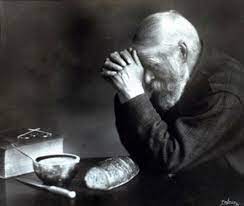
The Bread Line Mjassojedow, Grigorij Grigorjewitsch Moscow, Russia
Rules for the New Life
25 So then, putting away falsehood, let all of us speak the truth to our neighbors, for we are members of one another. 26 Be angry but do not sin; do not let the sun go down on your anger, 27 and do not make room for the devil. 28 Thieves must give up stealing; rather let them labor and work honestly with their own hands, so as to have something to share with the needy. 29 Let no evil talk come out of your mouths, but only what is useful for building up, as there is need, so that your words may give grace to those who hear. 30 And do not grieve the Holy Spirit of God, with which you were marked with a seal for the day of redemption. 31 Put away from you all bitterness and wrath and anger and wrangling and slander, together with all malice, 32 and be kind to one another, tenderhearted, forgiving one another, as God in Christ has forgiven you. 51 Therefore be imitators of God, as beloved children, 2 and live in love, as Christ loved us and gave himself up for us, a fragrant offering and sacrifice to God.
As years progress and the courses of history move from one era into another, those that live during the transition often wonder about the future. During the transitions of time things seem to change faster than the community can adjust, cultures move and people slowly adjust. During these periods of adjustment many begin to look to the past with nostalgic lenses wishing that things would return to a simpler time period, yet we often forget that those yester years were not as simple as we remember. Others look to the future with longing that all the problems would just go away without realizing that we must walk the paths to the future through the trials. I continue to speak in this manner because focusing solely on the past or the future can leave us blind to the present, and the present is the most important time and place to be. But it is difficult to keep our presence of mind focused during transitional periods because there are so many pressures squeezing around us, pressures that make us feel as if everything we once knew no longer matters.
We are living in transitional times of history. We are witnessing the first stages of the next great awakening. Just over the horizons of time we will see something beyond our wildest dreams, something that will give us hope and passion. We are going to see God build his kingdom here. How do we get there is the greatest question. How do we move from this seemingly hopeless state we often feel ourselves living in and move into the construction zone of the kingdom? Friends the reality is that we are already there.
The first century Church at Ephesus experienced similar things that we are experiencing today. I know this because they are just as human as we are, I know this because every generation views the past with nostalgic lenses and the future with smoke and mirrors. I know this because I like the music of my youth and think the music of today is horrid, just as my parents thought and their parents before them. Yet the church in Ephesus was not held back by these thoughts but boldly proceeded into the future and saw the kingdom grow on earth as it is in Heaven.
The key is to focus on what matters. Paul opens this passage by saying, “So then, putting away falsehood, let all of us speak the truth to our neighbors, for we are members of one another.” This is an amazing statement, because prior to this He had been speaking to the Jewish and the Gentiles attempting to reconcile the differences between them, going so far as saying that we all entered this world equal, none were born more righteous than anyone else, all were born uncircumcised until we were brought into the community of the faithful. This church in Ephesus was facing major struggles, the Jewish community had been living, working, and worshiping in this place for over 300 years and suddenly the culture was shifting and now after 300 years there were gentiles coming to faith. How were they to handle this change?
Paul says, “Put away the falsehood, stop playing games and justifying actions, and be real.” That is where we must begin. The number one complaint against the people outside of the formal church is that people are hypocrites or fake. The contemporary generation is even more sensitive to this than the previous generation. The generation that is moving into adulthood today are tired of people playing games, saying words that they have no intention of keeping and people acting contrary to what they say they believe. To them it is a total waste of time and energy to put on a façade, or to act. Why waste the energy to convince people of something everyone knows is a lie? Many of us here today look at this emerging generation with disdain because they do not respect or honor authority, we see this a rebellion, but this current generation is probably the most honest generation that America has ever seen.
Put away the falsehood and be real. This passage should deeply resonate with Friends because this is really the core of our faith. Honesty and integrity are one of the pillars of our faith that stretches across the entire spectrum of Quakerdom. People knew and respected the integrity of our culture to such a degree that the name Quaker represented truthfulness and quality. There is something important in that, there is something very important in authenticity 2000 years ago up to today.
Paul does not stop with authenticity though he goes on to say, “speak the truth to our neighbors, for we are members of one another.” We are members of one another. This is a profound statement. No matter how independent we think we are there is a deeply rooted need for community. We may perceive that we have made our own way, but we are members of one another. I know many of us do not like this thought, but I want us to consider it for a moment. I do not stand here alone. I stand here because of generations of ancestors that have gone before me. I stand here because someone took the time to talk to a young man and listen to all the questions. I stand here because a community saw a broken man and instead of judging the past they looked beneath the surface and saw something more. I stand because someone invested their life into mine because we are members of one another. I could stand and list off the names of those people that realized that they had a responsibility Leo, Earl, John, James, Leslie, Lois, Bob, Carol, David, Charles, Vicki, Cliff, Candice, Donna, Virl, Larry, and many more… common names, names of people that may not be considered great in anyone’s eyes but mine. They are the names of church members, grandparents, aunts and uncles, and friends. We are all members of one another, members of the kingdom.
Those people that moved beyond, they looked beneath the surface and began to nurture within me something that no one else saw. They invested their lives and spoke the truth. They showed me the gospel not in word but in life. They fed me, clothed me, taught me, you might say they had to they were family, but you do not know which of them is the most important or why.
I say this because the kingdom of God is built on the lives of common people doing common things. The kingdom is built by each of us seeing into the very hearts of those around us and recognizing that spark of light within, and nourishing that light.
The only way to nourish the light is to be authentic. Just like everything else discipleship is a cyclical process. For us to encourage the light to grow within someone else we must feed it with the light living inside of us, showing them life. For many we look at this passage and we can easily be confused because it sounds contradictory. Paul says be angry and then a couple of verses later he says not to be angry. Because of this I looked up the words just to see if maybe they were different, thinking maybe there might be two types of anger that Paul is speaking about. But it is the same. Anger is anger. Wrath is wrath. Paul is saying be real. If you are angry, be angry but do not sin, do not let the sun go down on your anger. We can disagree on many things but we should never let that disagreement harm the relationship, if it is something that might we must do what we can to reconcile the friendship. If we neglect this process of reconciliation, if we allow the emotions of anger to dominate our lives and cause division within our community, we are allowing the unholy to reign in our lives.
The community, the Kingdom of God that is around and in us is the most important thing we should pursue. This is what Paul is telling the Ephesians. They were dividing, choosing sides and pointing fingers at others. They were neglecting their first love. This is seen in how they speak to one another and how they treat those around them. They were allowing disagreements to damage friendships and they were allowing friendships to die because they were unwilling to forgive. But there is more. Anger and Theft are mentioned directly. This concept of thieves is very interesting because it really is not what it appear.
The ancient world was a world that was dominated by classes of people. There were nobles, freemen, and slaves. If you think there is economic disparity today the ancient world was much worse. The nobles controlled everything. The concept of thieves that Paul is mentioning is actually speaking to the way freemen and slaves relate to the Nobles. If a nobleman considered your good or service not to their liking they could charge you with theft and you would be convicted. The church was beginning to grow and people were turning away from the religions of old, this was causing cultural rifts. Slaves were beginning to see themselves as equals in the eyes of the divine and were no longer easy to control, so the nobles were charging the early Christians with theft because they were stealing property and food. Paul actually has a bit of humor in this passage because he is saying you thieves work stop stealing and do your job. But do not just do it do it better than the others so that you will not be seen as a thief any longer. Work harder and use the fruit of your labor to help others. Freemen likewise use the wages you earn benefit the community. Again he is reminding those in the church of Ephesus that the community and the relationships within are of greater importance.
This humor is not all fun because he is also addressing another very real concern within the Greek and roman cultures. Within the culture was an idea that the intelligent and philosophical minded people could become benefactor. These sages would expect a free ride in life because they were passing on wisdom. So as people grew in knowledge they would begin to expect the church to pay their way. This joke just became a double edged sword especially to those who wielded influence over others. Paul is calling them thieves as well, because everyone should be laboring and helping others within the community. No one person is of greater importance we all have jobs to do and a responsibility to those in need. Pastors cannot demand payment beyond the means of the community and in the same sense the community cannot withhold from their leaders proper compensation for the services they provide to the community. Again a cycle, a cycle based on honoring the relationship of all within the community.
Right after Paul calls everyone a thief he then proceeds to focus in on how to speak to one another. The words we say should be simple, plain, and truthful but they should be spoken in a manner to encourage growth, grace, and a deepening of the kingdom. When we act we should be putting others before ourselves and when we speak our words should be filled with the same intent. We should be mindful of how our words will be heard and quick to recognize when we may have been misunderstood. If the words we used insight anger we should strive to reconcile the relationship. Easy right!
Paul pretty punches each of us right in the gut. He hits our individual liberty, he cause us thieves, and he tells us to work harder, to speak truth, but not incite anger. He basically tells us that what we think is not really all that important and the worst thing about it is he is right. Be imitators of God, live the love of Christ with others, make your life a fragrant offering to God. The first must become the last and the last the first, the greatest in the kingdom must become the servant of all. It cycles back to the beginning again be real and speak the truth to your neighbor because we are members of one another.
I speak of a new era emerging around us, I speak of transitional history, and how the kingdom of God is just on the horizon. I say this because I believe it to be true. The emerging generation wants truth, they want reality and they do not have time to waste of anything fake. They are crying out for the gospel, they are seeking the very thing we say we have so why are so many leaving the community? Friends this is not a testimony of how bad the culture and the world is around us but a testimony of how we have distorted the gospel in the past. But there is hope. Jesus did not come to save the righteous but the sinners, he came to heal the broken and the sick, to restore to life those that were caught in the grips of death. He came to give us life, life filled with the things that matter to Him. We are in the construction zone of the kingdom God is working all around us and He is calling us all to speak the truth to our neighbor, because those people outside of these walls are the very people He wants and we are not his people until we recognize them as our people. As we enter into this time of Open worship and Holy expectancy I want us to consider these words of Paul. Have we caused anger to control our lives, have we become thieves to our own community, have we neglected imitating God in how we interact with those around us? Are we willing to repent? Are we willing to look beyond the surface and nourish the light within other?