Jwquaker's Blog
spiritual disciplines
The Kingdom of the Vengeance of Man or the Kingdom of the Forgiveness of God? (Sermon September 14, 2014)
Matthew 18:21–35 (NRSV)
Forgiveness
21 Then Peter came and said to him, “Lord, if another member of the church sins against me, how often should I forgive? As many as seven times?” 22 Jesus said to him, “Not seven times, but, I tell you, seventy-seven times.
The Parable of the Unforgiving Servant

Riot police in Ukraine fell to their knees to ask for forgiveness for their colleagues who shot and beat antigovernment protesters in the recent Kiev massacre. PUBLISHED: 06:12 EST, 25 February 2014 | UPDATED: 10:10 EST, 25 February 2014 Read more: http://www.dailymail.co.uk/news/article-2567420/Begging-forgiveness-riot-police-blamed-dozens-deaths-Kiev-Brutal-security-forces-knees-greeted-shouts-shame.html#ixzz3DG9t9yAA Follow us: @MailOnline on Twitter | DailyMail on Facebook
23 “For this reason the kingdom of heaven may be compared to a king who wished to settle accounts with his slaves. 24 When he began the reckoning, one who owed him ten thousand talents was brought to him; 25 and, as he could not pay, his lord ordered him to be sold, together with his wife and children and all his possessions, and payment to be made. 26 So the slave fell on his knees before him, saying, ‘Have patience with me, and I will pay you everything.’ 27 And out of pity for him, the lord of that slave released him and forgave him the debt. 28 But that same slave, as he went out, came upon one of his fellow slaves who owed him a hundred denarii; and seizing him by the throat, he said, ‘Pay what you owe.’ 29 Then his fellow slave fell down and pleaded with him, ‘Have patience with me, and I will pay you.’ 30 But he refused; then he went and threw him into prison until he would pay the debt. 31 When his fellow slaves saw what had happened, they were greatly distressed, and they went and reported to their lord all that had taken place. 32 Then his lord summoned him and said to him, ‘You wicked slave! I forgave you all that debt because you pleaded with me. 33 Should you not have had mercy on your fellow slave, as I had mercy on you?’ 34 And in anger his lord handed him over to be tortured until he would pay his entire debt. 35 So my heavenly Father will also do to every one of you, if you do not forgive your brother or sister from your heart.”
Of all the disciplines of Christianity forgiveness is probably one of the hardest and most necessary ones. It is forgiveness that sets the followers of Jesus apart from the other faiths. Not so much that the other faiths do not have forgiveness included in their tenets but because the conditions for forgiveness are radically different.
Most people believe that forgiveness has conditions, meaning that if someone is remorseful then you should forgive. This is not how Christ taught his followers to forgive. They forgive first and then would seek repentance for the wrong doing after forgiveness has already happened. Last week we discussed how if someone in your community were to sin against you, or to hinder or cause harm to your relationship that it is your responsibility to go to them to attempt to restore the relationship. If they do not respond to you then you were to take others with you to again try to restore the relationship. And if they still do not respond to take the community or church with you, if they still do not respond then we are then to treat them as gentiles and begin the ministry of building a relationship all over. We cannot do this without forgiveness being at the very core of our faith.
To forgive is to let go, to leave behind, and to depart from. If we are forgiving sin or actions that have caused harm to our relationships we are letting go of the hurt not allowing it to control the future of our relationship. That I think is the key. Not letting the hurt control the future of the relationship. When we let the harm someone has done to us, either intentionally or un-intentionally, control the future of our relationship we are letting sin, or anything that hinders our relationships with others or with God, control our lives.
Have you ever really thought about that? When we lack forgiveness we are letting sin control our lives. Jesus came to free us from the grips of sin, he suffered on the cross to release the bondage of sin from our lives. He lived to teach and show us a lifestyle where forgiveness and grace dominated and vengeance faded to the background. But it is extremely difficult to live a lifestyle of forgiveness and grace because we live around people that are just plain irritating.
This is where the great theologian Peter comes to help us out. Peter asks, “Lord, if another member of the church sins against me, how often should I forgive? As many as seven times?” Before we move on I want us all to recognize that Peter is actually being very gracious when he says this. The rabbinical teachings of the day said that it was only necessary to forgive someone three times, so Peter knowing that Jesus was teaching grace, repentance and forgiveness of sins was actually going above and beyond the teachings of the religious leaders. Seven is a good number, it is filled with powerful symbolism, and grace. The number six is the number that represents mankind, yet the number seven represents the completeness of man in communion with God during the Sabbath, where all has been created and God rested in the pleasure of his creation and we rest in his glory as well. So by suggesting the sevenfold forgiveness he is actually using the creative and imaginative portions of his brain to interact with God. It is actually a great suggestion and if we would actually forgive a mere seven times our world and our relationships with each other would be much stronger. But Jesus answers him, “Not seven times, but, I tell you, seventy-seven times.”
This is where the language and translations get pretty interesting, because other translations will translate this passage as seventy times seven. For most of us because we live in an era where we have things like mathematic and algebra we immediately begin to calculate this in our minds and we come up with a number 490. This is a pretty big number, and even if our minds do the math we get the general idea of what is being said, that we need to forgive a lot. But ancient cultures did not do math in the same ways that we do. If you think common core is confusing the mathematics of the ancient pre-Arabic number systems is even more confusing. Because of this very few people knew much about numbers so when they use large numbers it is generally in the figurative sense, so in this case it simply means un-calculable. So how many of us are actually going to keep a chart to track our forgiving of sin to the 490th time?
But what is interesting is that even though it simply means that we should be looking at it as forgiving without ceasing, Jesus is also speaking very symbolically. If we would look at Genesis chapter 4 we would get a clearer understanding of what Jesus is saying. This chapter of Genesis gives us one of the clearest pictures of a people devoted to God and people devoted to themselves because this chapter begins with the story of Cain and his brother Abel. Most of us know that Cain and Abel both offered sacrifices to God, Cain offered a gift from the fields and Abel offered a gift from the herds. Some look at this story and see that God accepted the gift of the animal because of the blood, but I think the attitude of the giver had more to do with the acceptance of God than the actual gift, the language used states that Cain brought some of the harvest, where Abel brought the best of the herds. Suggesting that the reason for the rejection is that Cain’s gift was not the best or first of the crop but was what was left after he took his personal portion. But because of the rejection from God Cain became jealous of his brother Abel and killed him. As a result God cursed Cain and then guarded him saying that anyone that would kill Cain out of vengeance would be met with sevenfold vengeance, I want us to remember that number seven. Cain went on to become a father, a grandfather, a great grandfather to the sixth generation. This man of the sixth generation was a man by the name of Lamech. It was Cain’s line that began civilization, Cain built the first city, and Lamech’s family was the one that first began participating in the cultural arts like poetry and metal working. We look at Cain with disdain but I want us to remember that Cain’s descendants are in the genealogy of Jesus as well those from the line of Seth (Adam and Eve’s third child). And Lamech is included in that list of names. With that being said it does not mean that this family and this budding culture that came from Cain’s descendants were good people. Lamech wrote a poem to his wives stating that if Cain was avenged sevenfold than he would be avenged seventy times seven times. From this story we get the separation of the people of God and the people of man. The sons of God were the ones that followed the traditions of Abel, where the sons of man were the ones that followed the paths of Lamech. The path of vengeance and selfishness. Seeking only personal gain instead of building a society based on the completeness of creation in communion with God. Which leads us to the story of Noah, where the sons of God were marrying the daughters of man and thus the world was growing increasingly more selfish and focused on a lifestyle of vengeance and less on grace and communion.
These stories of the ancients were very real to the Hebrew people during the time of Jesus. They grew up listening to these stories and learning from the sins of the past and how the lifestyles of those ancient people would lead to the trouble. Even within the discourse between Peter and Jesus we see a parallel between the conversations between the ancients; Cain would be avenged sevenfold and Peter seeks to forgive sevenfold, Lamech will avenge seventy times seven times and Jesus teaches that we should forgive seventy times seven times. The kingdoms of man live in a culture of cyclical and infinite vengeance and the kingdom of God is a culture built on cyclical and infinite grace.
To me that is profound and powerful. We live in a culture that where vengeance is often the dominant theme. We hear sermons preached from pulpits across the land that tell us to repent or chance the fires of hell, but what are they really teaching, often it has very little to do with the love and grace of the kingdom of God, but instead is focusing on the vengeance of man. We hear on the news of extremist groups perpetuating a culture of death and vengeance and what is the response of many from a nation that claims to be built on the Christian faith and Christian values? Sadly it is not a message of grace, but is often marinated with the same ingredients of vengeance. This is not the Kingdom of God, this is the kingdoms of man working against each other, this is the sons of God becoming intimate with the daughters of man and letting the easy road of selfishness, vengeance and sin dominate the life. Instead of taking the hard road of building up the community on grace.
The kingdom of God is not one that is easy to enter. It is a lifestyle that takes discipline. It is a life that requires a community and a church that meets together to provide encouragement. Where the weak are encouraged and strengthened by those that are stronger. To live the lifestyle of Christ we need the constant communion with God in prayer where the very spirit of God will fill, teach and direct our lives showing us where we have hindered the development of the relationships with mankind and with God and providing the grace and strength to reconcile with each. It also requires that we respond to the Spirit of God and move out into the community around us serve those sons and daughters of Man so that maybe through the example of our lives lived among them they may begin to listen to that voice of God that is ever urging them to repent and turn to God.
As we prepare to enter into this time of open worship, I want us to consider these lifestyles the sevenfold and seventy times sevenfold lifestyles, one built on vengeance and one built on mercy, one built on selfishness the other of grace. I ask which culture are we building in the community around us. Are we living in the Kingdom of man or are we living in the Kingdom of God?
Building Community (Sermon September 7, 2014)
Matthew 18:15–20 (NRSV)
Reproving Another Who Sins
15 “If another member of the church sins against you, go and point out the fault when the two of you are alone. If the member listens to you, you have regained that one. 16 But if you are not listened to, take one or two others along with you, so that every word may be confirmed by the evidence of two or  three witnesses. 17 If the member refuses to listen to them, tell it to the church; and if the offender refuses to listen even to the church, let such a one be to you as a Gentile and a tax collector. 18 Truly I tell you, whatever you bind on earth will be bound in heaven, and whatever you loose on earth will be loosed in heaven. 19 Again, truly I tell you, if two of you agree on earth about anything you ask, it will be done for you by my Father in heaven. 20 For where two or three are gathered in my name, I am there among them.”
All too often in our culture we are quick to jump to conclusions and slow to change our point of view. We are quick with a lawsuit when we feel wronged for the slightest offence, and when things do not go our way we rush back into the controversy until somehow we are appeased. My main job outside of the church is to keep the store I work out of the courtroom, because even the slightest injury can be blown out of proportion causing great loss of time and money. Why has our culture come to this? Because we no longer know how to live with one another.
This teaching of Jesus gets to the heart of interpersonal relationships. Most people hear these verses only during a time of controversy because we have often labeled this as being the doctrine of church discipline. But I want us to think about this for a moment at the time these words were spoken the church, as we know the church had yet to come into existence. Some would argue and say that when church is mentioned it means the synagogue but in this case church means the community.
I mention this because if we take this verse out of our traditional box we put it in and put it back into the context of the community it changes everything. When we leave it in the traditional box of how to treat people you have an argument with in the church, it becomes extremely difficult to actually use these guidelines to discipline anyone because we do not know how. But if we were to live these words out in our everyday life with the neighbor down the street, or the manager of the store these words become less of a guideline and become who we are.
Now more than any other time in our culture, we need to look at these words in the correct light. In a culture where there is a lawyer for every 265 people, looking for cases to litigate. Where a speedy trial can mean years instead of month due to the amount of cases in the court system. It is important that those that call themselves followers of Jesus do not get caught up in a worldly system that takes advantage of others. With that being said I am not speaking out against lawyers, they are professional people that provide a much needed service. What I am saying is that people are abusing the system.
But let us look deeper into this passage. The first thing I want us to look at is the word “you.” This passage is very much focused on the individual as an entity within the community. This is why this is not just church discipline but a teaching on how to live with others. How we live with others really falls into your own hands. “If another member of the church sins against you, go and point out the fault when the two of you are alone. If the member listens to you, you have regained that one.” Although the verse says member of the church, I want us to remember that the word used can also mean neighbor, countryman, fellow believer, or member of the community. So let us look at this as, “If someone in your neighborhood sins against you…” This now causes us to consider what does “sins against you,” mean?
The concept of sin is one that confuses many in our current age. Often we consider sin as a transgression against God, or a violation of the laws of God. This is one way of looking at it, but this is a very legalistic approach one that often discourages instead of encourages. Another way to look at sin is something that hinders relationships; relationships between humans and relationships between God and humanity. This view of sin is the view I would like us to use when looking at this passage, mainly because if we look at it strictly from a legalistic view the relational aspect of the passage can be missed.
So someone in the neighborhood has sinned or has done something to hinder our relationship with each other. They have offended you in some way. What do you do? Again it goes back to you, because how we relate to others is in our own hands. Someone has offended you, someone has done something that may cause harm to your relationship. It is much easier to look at this passage from an abstract church discipline point of view because it takes you out of the picture. But Jesus is very clear, you must do something.
If someone has offended you, if someone has done something to harm or hinder your relationship with them it is your responsibility to do something about it. If you do not do anything to correct the situation then you do not have any right to be offended. I say this because they very well may not realize that they have caused or potentially have caused harm. They could not know because they cannot know you unless you reveal yourself to them, they do know your sensitivities or your weaknesses unless you tell them. They cannot know that they have harmed you because they do not know you unless you have shared your life with them. These guidelines are there to encourage us to take the first steps.
Someone in the neighborhood, in the community has hindered or has potentially hindered your friendship with them. That is what this passage means. That someone through words or actions has offended or has potentially cause harm to you. And Jesus says that if this has happened you must go to them and share with them how that action or those words could hinder your relationship with them. This is not how we generally live in our culture today. But imagine if we actually lived like this? Imagine if we were to actually go to our neighbor and talk to them over coffee and let them who we are and find out who they are. Imagine if when something did happen we were able to just go to them and let them know what is bothering us. Imagine if we lived in a community that respect for others was important.
If we have not taken the time to build a relationship with someone how are they supposed to know that their actions are hindering our friendship? Let us be honest, if we have not taken the time to build a relationship with them we do not have a friendship. If there is not a friendship then how can we be offended? If we are not building friendships then what is left is selfishness demanding conformity with no regard for the humanity of others. This is what the world is all about, selfish desires being demanded from others.
I will share with you a few examples from my own life, because I have a gift of being offensive. When Kristy and I left the Meeting in Arkansas City and moved to Wichita we lived in an apartment complex. We were watching a movie in our apartment one evening and then went to bed, only to have a knock on the door by a police officer. The officer said that someone had called to report that we were playing loud music and wanted us to stop. By the time the officer came we were in bed, I answered the door in my pajamas. I bring this up because I had offended someone, I did not know that I had offended anyone, I was not in any violation of the rules of the complex so how was I to know that I would be offending anyone, but instead of our neighbors coming to us and asking us to turn down the volume they called the police. After that incident we did not feel welcome in our own home, after that incident we felt as if we could not enjoy our lives, and we moved the first opportunity we could. The person who called the police was focused on the legality instead of the relationship. They sought to force us to conform to their schedule instead of asking us to consider their needs. There was another time when after a conversation in the break room at work a coworker of mine came to me and discussed how the topic of conversation that day was offensive to them and they felt that maybe we should not have discussed it. Although I had to think more deeply about what might offend that individual when we discussed things in the break room the friendship remained because they took the time to speak. In the first example community was not built, instead it was broken apart, in the second example although I personally was rebuked for being offensive the community was strengthened. But in each case the relationship was held in the hands of the offended party.
Jesus urges us to go to them personally because when we speak to each other we are known to one another. That personal meeting is vital. In most cases if a neighbor knows that their actions are causing harm to those around them they will adjust their behavior. But what if that individual does not adjust their behavior? This is where other parties are initiated to enter into the conversation. Why is it important to wait to get others involved? In my first example the police were called to confront me, this action caused us to feel unwelcome in our own home. It cause me to look at things in that community differently, I began to consider my neighbors differently when I heard an argument coming through the vents I thought about calling the cops on them, when people were enjoying their weekend at the pool I wanted a strict enforcement of the rules after dark. I wanted to retaliate because someone thought ill of me and wanted to force me to turn down the volume, so I wanted everyone in that community to suffer. But I did not engage the community, I did not even want to be in that community. When we neglect the building of friendships our outlook becomes very negative. When we skip the personal confrontation and jump to bringing other into the conversation we risk tearing the community apart before it even begins to form. But if someone does not change behavior after we talk to them and others in the community are also offended then together we can approach the individual and maybe then things can change.
Jesus then says if they do not listen to the group then take it up with the church, or the assembly of the community, and if they still do not listen treat them as a gentile or a tax collector. Often this is where this passage gets confusing, because when used as church discipline they regard that as removal from the church, but if we look at this as community building then how would Jesus treat the Gentile or the tax collector? Those offensive people become the ones we direct our ministry toward. The one that is offensive becomes the one that we focus our love and service to. So they reject us, we will let them know that we do not reject them. So they disrespect us we will not let their disrespect cause us to disrespect them. Imagine again if we actually lived like this?
Instead of calling the police on the offensive person we invite them to dinner. Instead of complaining that they have wronged us and hold a grudge for the next few years we do the best we can to build a friendship with them. What would happen then?
What would happen in our community as a whole if every follower of Jesus would live this passage out in their lives daily? There was a time when this was how followers of Jesus lived. There was a time when, even though being a Christian could cost your life people would continue to approach their neighbors to offer them friendship. There was a time when the followers of Jesus would face a sentence to jail before they would stop attempting to build the community to honor Christ. There was a time…
But what has happened? What has happened to the followers of Jesus that we would turn from this lifestyle of building friendships with those outside the community and instead fight? What has happened to the followers of Jesus that we would call each other to war instead of calling an enemy into friendship? There was a time, and there is time. We live in a culture that this lifestyle that Jesus encourages us to live is so foreign that it would change people’s perspectives. We live in a world that is so prone to lawsuits that when someone does not make that demand, it makes an impression. There is time for us to begin building this community for Christ. But it all depends on you and what you do with the time God has given you.
Jesus concludes this lesson by saying some of the most powerful words we will ever hear. “Truly I tell you, whatever you bind on earth will be bound in heaven, and whatever you loose on earth will be loosed in heaven. Again, truly I tell you, if two of you agree on earth about anything you ask, it will be done for you by my Father in heaven. For where two or three are gathered in my name, I am there among them.” You have the power to bind and loose, you have the power to release and damn, you have the power to bring the kingdom of heaven to earth or open the gates of hell. That is amazing power that God has given to us. It is ours because how we respond when people offend us opens or closes doors. Here is the most important thing, it is not the person that offends that is being bound or loosened, it is you. You have the power to open the gates of heaven or to seal the doors closed on yourself. You have the power to live in the kingdom, building community in your own neighborhood, or you have the power to participate in the perpetuation of the worldly system.
No matter what others in the community do you are only responsible for yourself. But how we as followers of Jesus respond to those in our community can encourage others to consider their own lives. There was a time when people lived like this, there is time to do it again.
Hearing the Spirit and find the Rock (Sermon August 24, 2014)
Matthew 16:13–20 (NRSV)
Peter’s Declaration about Jesus
(Mk 8:27–30; Lk 9:18–20)
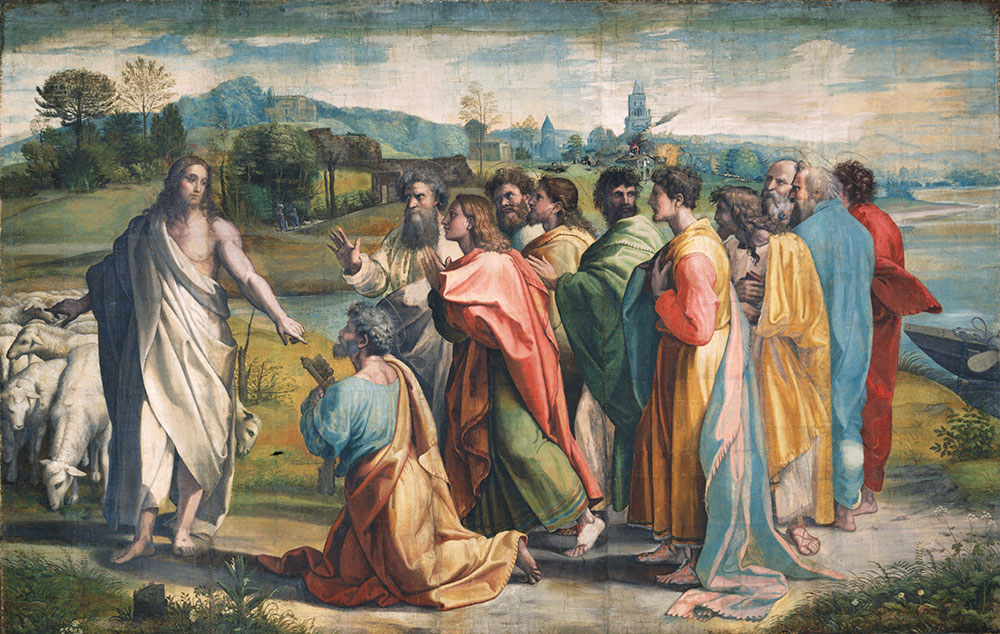
Raphael, 1515-1516
Victoria and Albert Museum, London, Great Britain
13 Now when Jesus came into the district of Caesarea Philippi, he asked his disciples, “Who do people say that the Son of Man is?” 14 And they said, “Some say John the Baptist, but others Elijah, and still others Jeremiah or one of the prophets.” 15 He said to them, “But who do you say that I am?” 16 Simon Peter answered, “You are the Messiah, the Son of the living God.” 17 And Jesus answered him, “Blessed are you, Simon son of Jonah! For flesh and blood has not revealed this to you, but my Father in heaven. 18 And I tell you, you are Peter, and on this rock I will build my church, and the gates of Hades will not prevail against it. 19 I will give you the keys of the kingdom of heaven, and whatever you bind on earth will be bound in heaven, and whatever you loose on earth will be loosed in heaven.” 20 Then he sternly ordered the disciples not to tell anyone that he was the Messiah.
How often do we take the time to really consider how we got to the place that we are? I know it is an odd question and probably not one that many of us even want to consider, but so often our culture wants us to forget about cause and effect. If you eat fast food everyday chances are you are going to have serious health problems in the future. If you sit all day at a computer your body will develop odd configurations of your bones. There are always cause and effect relationships. I want us to consider these relationships as we reflect on this passage today.
Jesus has gone to the northern part of what we call Israel to a town named after the emperor of Rome and the son of Herod the great. Caesarea Philippi is a very interesting place. It is a deeply religious place, it was one of the centers of Baal worship, and was also a major center for the worship of the Greek god Pan. The town was one that had been renamed multiple times but the interesting thing about the name is that it has a similar theme: Baal-Gad or Hermon, Paneas, Caesarea Philippi, and even the current name Baneas all point to the worship of a god that is not the God of the Hebrew people. But there is still a connection.
This city is at the base of mount Hermon which is important in history because this is the place where after the Generals of Alexander the Great divided the Greek Empire the Egyptian branch and Persian branch fought over what we know as Israel, and Antiochus III defeated Ptolemies (the Egyptian ruler) and allowed the Jewish people to freely immigrate back to the land of their ancestors. Antiochus the great was a friend of the Jewish people, but his son Antiochus IV was the one that desecrated the temple which started the rebellion and subsequent independence of Israel under the Hasmonean Dynasty. It was at this Mount courses of history began.
But there is more this mountain has a cave with a large body of water inside, a pool of water that was seen as a gateway into the underworld because it was so deep and dark one could not begin to imagine where it ended, and this pool of water is considered one of the sources of the river Jordan.
So here at the source of the Jordan, the very river that was used to initiate the ministry of Jesus, at the site of one of the largest and most active pagan shrines Jesus asks his disciples to examine themselves and their understanding of who He is. At this cultural cross road they are challenged. “Who do they say that I am?”
This discourse between Jesus and his disciples beginning of a new era, it is the start of the next chapter of the history of faith. “Who do they say I am?” and “Who do you say that I am.” The question was asked not in Jerusalem or even in Judea, but on the very northern border of Israel nearly outside of the land of their ancestors, laying in the disputed area between Lebanon, Syria, and Israel known as the Golan Heights. Even today this is a historical and cultural crossroad.
But now I want to jump forward and consider the response to the question. The apostle we know as Peter responded, “You are the Messiah, the son of the Living God.” This response has great value, not only does it establish that the disciples were beginning to understand that Jesus was more than just a Rabbi, it was also developing a newer understanding of the very nature of God. It is here that Jesus then gives Simon his second name Peter. But the explanation of this name change is what is most interesting.
“Blessed are you, Simon son of Jonah! For flesh and blood has not revealed this to you, but my Father in heaven. 18 And I tell you, you are Peter, and on this rock I will build my church…” There are several things happening here. First though we need to understand why Jesus gave him a new name to begin with. In many ancient cultures, especially the Hebrew culture a name carries great meaning. The meaning of the name is often a prophetic declaration of the individual. There are three names mentioned in this response by Jesus: Simon, Jonah, and Peter. Each name has significant meaning. Simon means, “He has heard”.
He has heard, what a prophetic name for one of the disciples that heard and listened to the calling of Jesus to follow. It was Simon that basically took the leadership role of the apostles. He has heard. Along with hearing comes the more active form of listening. So not only does Simon hear, but he listens.
The second name is Jonah. Jonah is an interesting name because it could mean two very different things. In most cases it means dove. The dove was used in the worship at the temple, and has long been associated in the church as the symbol of the Holy Spirit, mainly because that was the visual imagery used in describing the spirit deciding on Jesus. But Jonah also has a negative connotation to it. Hebrew is a language where the written form does not use vowels, so the reader must insert them in their mind, so depending on the usage the written form of a word can take on a totally different meaning. In the case of Jonah, dove or the bringer of grace through sacrifice, or it could also mean to vex, or oppress. So this name could be a blessing or a curse.
The third name is Peter which means stone. Now this is where it get interesting. Because Peter or Petros is not the type of rock that you would build a building out of, it is a fragile fragment of a rock. But the feminine form of the word, Petra is solid and is the type of rock that builders and artists would want to have access too. Petra is the word used for what the church is going to be built, but Petros is the name. Again both negative and positive aspects, and a prophetic message in both depending on which path one was to take.
So the message in the names can mean two things: 1. He hears and is vexed and crumbles, or 2. He hears the spirit and builds on a firm rock. The question Jesus asks again, “who do you say that I am.”
Jesus is standing there on the crossroads of culture, history, and faith and he is laying it out all out before them. They are saying things about me and you are saying things too, which are you going to believe? I mention this because we have all stood at a place very similar to this in our lives. We have faced a challenge and the decision that we would make at that moment would direct the course of our lives. How do we move forward, how do we see through the vexations and the blessings?
“Who do you say that I am?” Jesus is still asking that question to every person in every age. There are many answers to this question, and with each answer comes a very different path. There are those that say that Jesus is just a myth, a hopeful figment of the imagination of broken people. That answer will set a course in life. A course where the only strength available to you is what you personally possess. The problem with that is the constant erosion that is presented in the various aspects of life. Although you have the freedom to choose whatever you want to do with no bonds most that choose this path become bitter and broken people. They are hard to love because they have been hurt deeply by relationships and have no one to turn to but their own fragile stones.
Then there are those that equate Jesus to a good moral teacher, these people will often hear the teaching of Jesus and find them very appealing but are often swayed by other teachings that sound just as good. To them, Jesus is no different than any other religious founder, just a man with a good message. The path they tread is a bit more solid because they now have a moral guide that will help them deal with the struggles of life, but still they must rely only on their own strength.
Then there are those that believe as Simon Peter, “you are the Messiah, the son of the Living God.” Those that say this are set on a different course, one that does not rely on their strength but the collective strength of those in their community and in their weakness they have faith that God will provide the necessary power to overcome.
It sounds so simple in word, but in reality we all move up and down this spectrum with each major decision we face. With each there is a form of belief but only one is the type of belief that we are able to see the hand of God moving. We reach these crossroads and we choose. Will I move forward in myself, will I trust the ways of our spiritual forefathers, or will I step out and entrust all I have to God. How do we move forward, how do we move beyond into greater trust and belief?
Through listening. This is where Jesus will build his church. It is on those that will look beyond the worldly wisdoms, the moral codes of centuries of dogma, and will simply listen and follow. This is why Jesus came to live a full life, from prenatal existence, through childhood and on into adulthood. This is why he showed his disciples the holy rhythm of life of worship, prayer, and service. Because it is in that rhythm we can begin to listen and respond. It is in that rhythm where we make it our custom to join together in worship to encourage each other and praise God that we find the strength to take deeper steps into faith. When we withdraw to the isolated places to pray, we remove ourselves from the chaos of the world and can center down and hear the voice of God teaching, encouraging and calling us to action. And it is in service that our faith is tested and the fragile pebbles of our life are pressed into beautiful stone fit for building. Then the cycle begins again, because the testing of our faith and the pressure of service can discourage us so we go back into worship to have our community join with us to encourage once again, it is through our prayers in the isolated places where we again are called, and we are provided with the strength to minister once again.
It is that rhythm that is the key to the kingdom. It is that lifestyle of Jesus that the church is built. Because it is in that holy rhythm of devotion that reaches out the people marginalized by the world, leading defeated bitter lives. But the question still remains, “Who do you say that I am?” How we answer that question will determine how we approach the calling God is giving us. If we honestly say that He is the Messiah, the Son of the Living God, then we have access to the power that create out of nothing, and can use the insignificant to bring about the amazing. Who do you say He is?
As we enter into this time of open worship and holy expectancy, I want us each to examine our lives just for a bit, consider the choices that we have made in the past that have led us to where we are today, and ask God to reveal to us where and who our faith was in? Then I want us to imagine the future, where is God calling us? Are we hearing the voice of the spirit leading us to solid rock or are we being vexed by our own desires and standing on fragile stone?